
It was a good morning for AI investors. ☀️
With the latest headlines, we’re seeing AI investment translating into real business value. Companies are beginning to report tangible efficiencies from AI adoption, and the demand continues to grow.
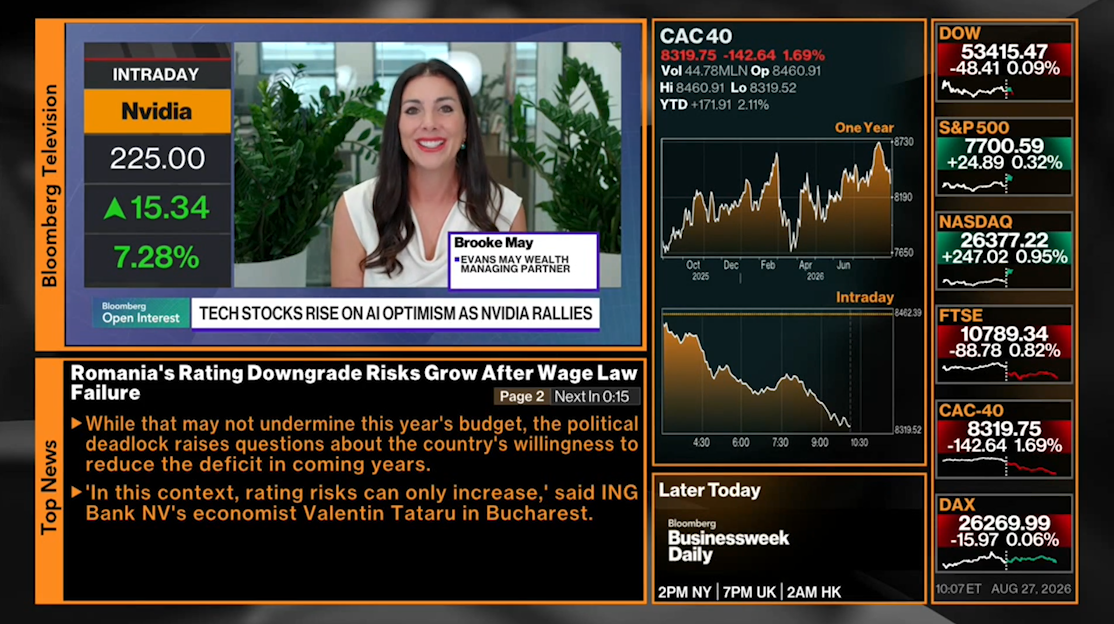
Watch Brooke’s Bloomberg interview to hear my take on what’s next in the AI story.
Transcript:
How important was it to get Nvidia not only have strong results, but get the kind of market reaction that we’re seeing this morning?
Host: Joining us now to continue the conversation is Evans May Wealth Managing Partner, Brooke May, who is herself an Nvidia shareholder. So, I’m sure you are enjoying the day today so far, Brooke. How important was it to get Nvidia not only have strong results, but get the kind of market reaction that we’re seeing this morning?
Brooke: As goes Nvidia, goes the market. And we’re clearly seeing that today. Their forecast and guidance was incredible. I think that we were really surprised by the potential for such strong revenue growth. For a company this size to continue to grow at this pace is phenomenal. And to see them expanding beyond the hyperscalers, offering a much, their services to a much wider base is the way to go right now to continue to see the revenue growth that we’ve seen historically.
Do you think Nvidia did enough to ease concerns and that this could take the market higher at this point?
Host: Hi, Brooke. We’ve seen so many things hanging over this AI trade. What we saw over the summer during that selloff, whether, you know, all this spending is sustainable, the circular nature of it. Do you think that Nvidia did enough to ease concerns around that and that this could take the market higher at this point?
Brooke: I definitely think that they’re easing concerns somewhat, but I do think that the circular financing and, you know, some of the other lending should be monitored.
I don’t think that there’s an overextension right now because demand is there. When you listen to earnings calls, 46% of companies indicated that they’re seeing AI efficiencies. That’s really just scratching the surface. And these companies haven’t gone all in. And we’re only seeing half of companies indicate that they’re seeing the efficiencies. So, there’s tremendous demand out there.
And we think that, you know, the loans that Nvidia’s [BC1.1]agreed to back up [BC2.1]to 25% being issued by this new consortium of big investment firms: KKR, Goldman, Blackstone, Blackrock. We’re going to see with that demand the need for, for capital. These neo clouds can’t cash flow like the hyperscalers can. And so, for Nvidia to be able to step in and backstop those loans, they believe that there’s enough of a residual value in a secondary market for those chips that there isn’t a big, there isn’t a big risk in making these, these loans.
Who are the benefiters of AI?
Host: Brooke, so, if we’re finally starting to see in the numbers for this earnings season, show up of AI efficiencies of corporates actually adopting this stuff and seeing some sort of profitability gain or at least margin compression from it, where are you seeing that? Now that we look through this earnings season, who are the benefiters of AI?
Brooke: Really, it’s broad and it’s trickling down now. You know, it’s not just the hyperscalers that are seeing benefits. You know, when we look at corporate margins, margins were almost 17% this quarter. That’s phenomenal. And when we look at the earnings growth, you know, [BC3.1]earnings growth is up 50% year-over-year. You factor out Amazon, Alphabet, we’re still seeing earnings growth for this quarter up more than 30%.
So that’s a broadening. And companies are seeing these efficiencies. Therefore, they’re going to continue to invest if they’re getting a return on capital.
How much is the margin story a factor for you when it comes to Nvidia?
Host: And Brooke how much is the margin story a factor for you when it comes to Nvidia? They pointed out that margins will be lower this year. Obviously, any company would be thrilled to have the margins that Nvidia has. But what does it also mean for the rest of the supply chain when it comes to the memory names and things like that?
Brooke: Yeah. Moving from 75% margin to 72% to 73% isn’t anything to, to, you know, snub your nose at. It’s still very, very strong. And I think that that says that there’s pricing power out there.
And it says to the suppliers the demand is there. The demand is going to continue to be there, continue to invest in your infrastructure so you can supply us with what we need to be able to meet the demand of our customers.
How big of an impact might Jackson Hole tomorrow have on markets based on what Kevin Warsh says or doesn’t say?
Host: Well, we’ve gone through this risk event and it’s a positive one for this market. We’re starting to price in that 70%.
Brooke, to what degree will we have done that by the end of today and now need to worry about the next risk event, which is Jackson Hole tomorrow, hearing from Kevin, from Kevin Warsh? Just how big of an impact might this have on market, markets based on what he says or doesn’t say?
Brooke: Yeah. All eyes will be on Jackson Hole, you know, the shift from Nvidia to Jackson Hole. And I think that we’re not going to, we’re not going to know too much more than we know today. You know, he’s indicated that he’s not going to be as transparent as Powell was in his statements. And I think he’s going to be focused more on the broader economy and AI and what that could mean.
Looking forward, is this becoming a more macro-driven market and does that mean more choppiness from here?
Host: And so, what does that mean for this market? Brooke, I made the point earlier that with earnings season largely behind us, and yes, it was a great earnings season, of course. But looking forward we have tomorrow’s risk event of Kevin Warsh. But looking forward, is this becoming a more, you know, macro-driven market? And so, does that mean more choppiness from here?
Brooke: Yeah. September, October tend to be the most volatile months in the market. So, we are setting the expectation, especially with this being a midterm election year. But at the end of the day, the market is going to trade off a multiple of earnings and earnings are strong. We don’t think that we’ll see, you know, the earnings growth that we’ve seen this quarter; however[BC4.1], we’re expecting double-digit, double-digit earnings growth in the foreseeable future.
And that bodes well for the market. It’s not just large caps either. You know we’re seeing really strong momentum in small cap, international. And just recently we’ve seen Bitcoin and gold participate. So, it really is a good time to be an investor. And you can have a broad diversified portfolio as opposed to just being concentrated in large, mega cap, Mag 7 companies.
Is the recent participation of gold and Bitcoin healthy if it’s based on renewed concerns about the dollar and a debasement trade?
Host: Is the recent participation, though, of gold and Bitcoin healthy, Brooke? If it’s based on renewed concerns about the dollar and a debasement trade?
Brooke: Yeah, it’s a, it’s a give and take. So, clearly you know that that rally is in response to concerns. So, I think that it’s something that we have to keep an eye on.
There, you know, we’re, we’re seeing right now a little bit of a conflict between, you know, the Treasury and the Fed, and you know, what’s going to happen with rates and inflation. And so, debasement is a concern. But, you know, gold, Bitcoin, that’s a way to diversify portfolios. It’s a non-correlated asset class that can actually reduce risk over time.
Host: Hey, Brooke, really great to catch up with you. What a day. What a week. Brooke May of Evans May Wealth, thank you so much.