
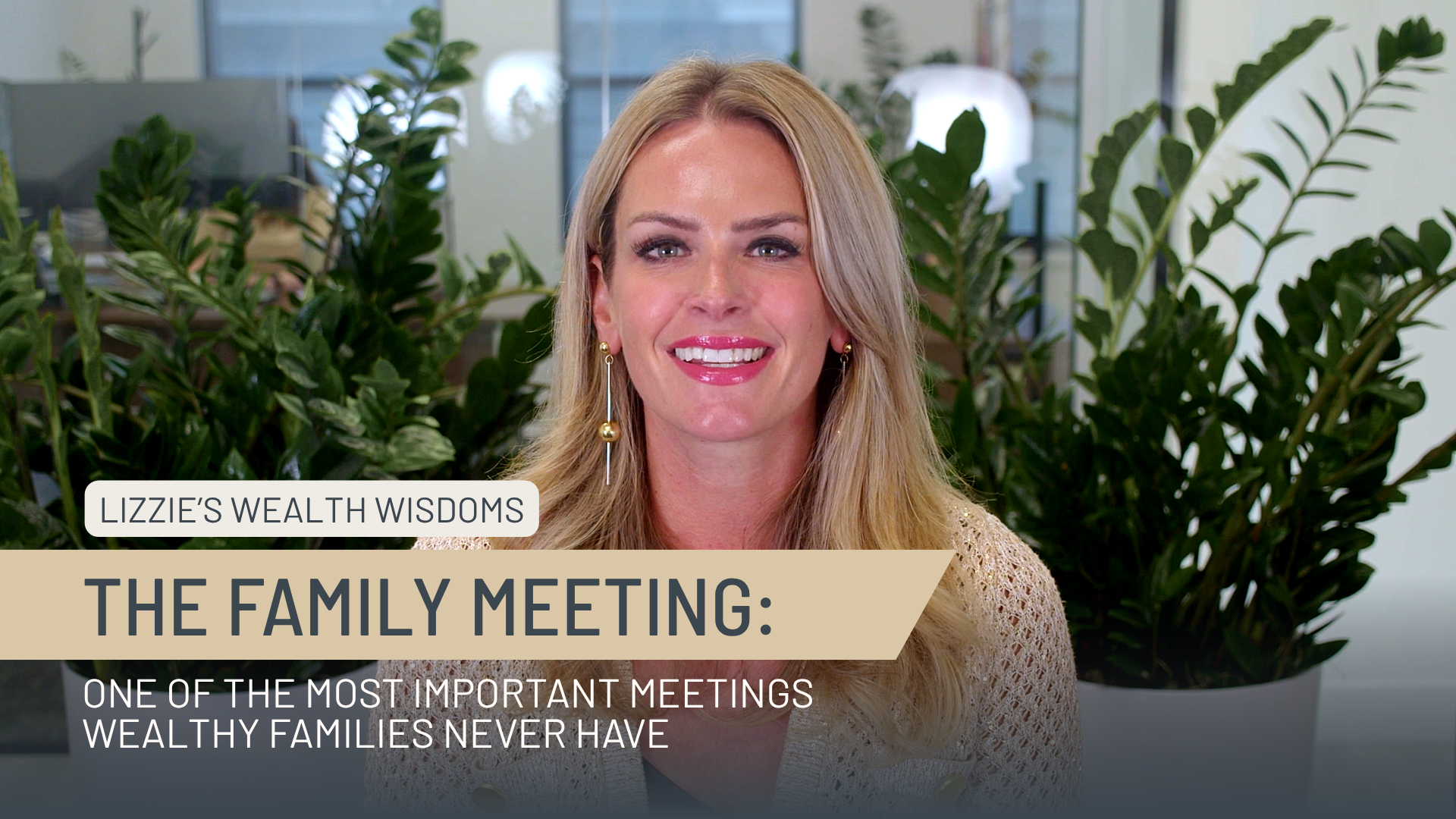

Passing down wealth is one thing. Preparing your family to receive it is another.
That’s where a Family Meeting can make a meaningful difference.
It’s a chance to bring multiple generations together to have important conversations about the goals, values, and intentions behind your wealth, not just what’s being passed down.
Because a lasting legacy isn’t just about transferring assets, it’s about helping the next generation understand what that wealth means and how to carry it forward.
Watch the latest Lizzie’s Wealth Wisdoms podcast episode to learn more! 👇
Transcript:
Hi, I’m Lizzie Evans, and welcome back to Lizzie’s Wealth Wisdoms. Today, I want to talk about something that has very little to do with investment returns, interest rates, or even taxes. But I believe it can be one of the most important parts of managing significant wealth. The family meeting.
We spend decades helping families accumulate wealth. We build investment portfolios. We create trusts, minimize taxes, establish charitable strategies, and carefully think through how assets will eventually pass from one generation to the next.
But there is one question that sometimes gets overlooked: Have you prepared your family for the wealth that they may someday inherit? Because there is a big difference between preparing your assets for your children and preparing your children for your assets. And I think that distinction becomes increasingly important as wealth grows.
When Should You Start Talking to Your Children About Money?
So, when should you start talking to your children about money? There is not a magic age. And I certainly don’t think your 18-year-old needs to know exactly what your net worth is or how much he or she may inherit one day. But I do think conversations about wealth should begin long before an inheritance does.
When children are young, that might simply mean teaching them that money requires choices. We can talk about saving, spending, giving, and working. As they get older, those conversations can evolve.
Why does our family give to certain charities? Why do we save and invest? What sacrifices did Mom, Dad, Grandma, or Grandpa make to build what we have today? What responsibilities come along with having financial resources?
And eventually, for families with significant wealth, those conversations become more sophisticated. That is where a family meeting can become incredibly valuable.
What Should You Actually Talk About in a Family Meeting?
So, what should you actually talk about? Here is the important part: A family meeting doesn’t have to begin with a balance sheet. In fact, I often think it shouldn’t.
You should start with values. What does your family believe about money? What do you hope your wealth accomplishes?
Maybe your priority is education. Maybe it’s entrepreneurship. Maybe it’s philanthropy. Maybe it’s giving your children opportunities while still expecting them to build lives and careers of their own. Maybe your goal is simply to make life a little easier for the next generation, but not so easy that you take away their motivation or sense of purpose.
Those are such important conversations. And once those values are understood, you can begin introducing some of the mechanics.
Who are the family’s advisors? Where are important documents located? Who is the trustee? Who has the power of attorney if something happens? What trusts exist, and why were they created? What should your children do if something unexpectedly happens to you?
You don’t necessarily have to disclose every dollar. You can provide a roadmap without handing someone the entire financial statement.
Benefits of Having a Family Meeting Early
And there is another benefit to doing this early. It gives your children the opportunity to build relationships with the people who may someday be helping them.
I would much rather meet a client’s children around a conference table while Mom and Dad are healthy and actively involved in the conversation than meet them for the first time after a parent has passed away. Those are two very different conversations.
If it’s a proactive conversation well before Mom and Dad have passed, children have the opportunity to ask questions. Parents have the opportunity to explain their decisions, and everyone walks away with a good understanding of what is supposed to happen. More importantly, everyone knows whom to call when life inevitably changes.
There is also a question I hear from parents all the time: “If I tell my children too much, will it change them?” And I think that that’s a very legitimate concern. Significant wealth can be an incredible blessing, but it can also affect motivation, relationships and decision-making if it isn’t handled thoughtfully.
That’s why I don’t think transparency necessarily means telling a 25-year-old, “Someday you’re going to inherit $10 million.”
Instead, it might mean saying, “We’ve been incredibly fortunate. We’ve planned carefully, and someday you may have financial resources available to you. We want you to understand how we think about money and the responsibility that comes with it.” That is a very different message.
Purpose of a Family Meeting
And finally, remember that your children may have questions you’ve never considered. They may view the family business very differently than you.
One child may want to be involved, while another may want to have nothing to do with it. One may be financially sophisticated, while another child feels completely overwhelmed by money. One may care deeply about philanthropy, and another may be incredibly passionate about entrepreneurship.
The purpose of a family meeting isn’t necessarily to make everyone think the same way. It’s to make sure everyone understands the plan—and, perhaps more importantly, the values behind the plan.
Because ultimately, successful wealth transfer isn’t simply about how much money survives from one generation to the next. It’s about whether the wisdom, responsibility, generosity, and values that created that wealth survive with it.
So, if you have spent years building an estate plan, but have never sat down with the people who will someday inherit it, perhaps your next planning meeting shouldn’t be about investments at all. Maybe it should be having a family meeting.
I’m Lizzie Evans, and that’s today’s Wealth Wisdom.