
Higher rates don’t necessarily mean it’s time to step away from equities.
It might mean investors should be more selective, though.
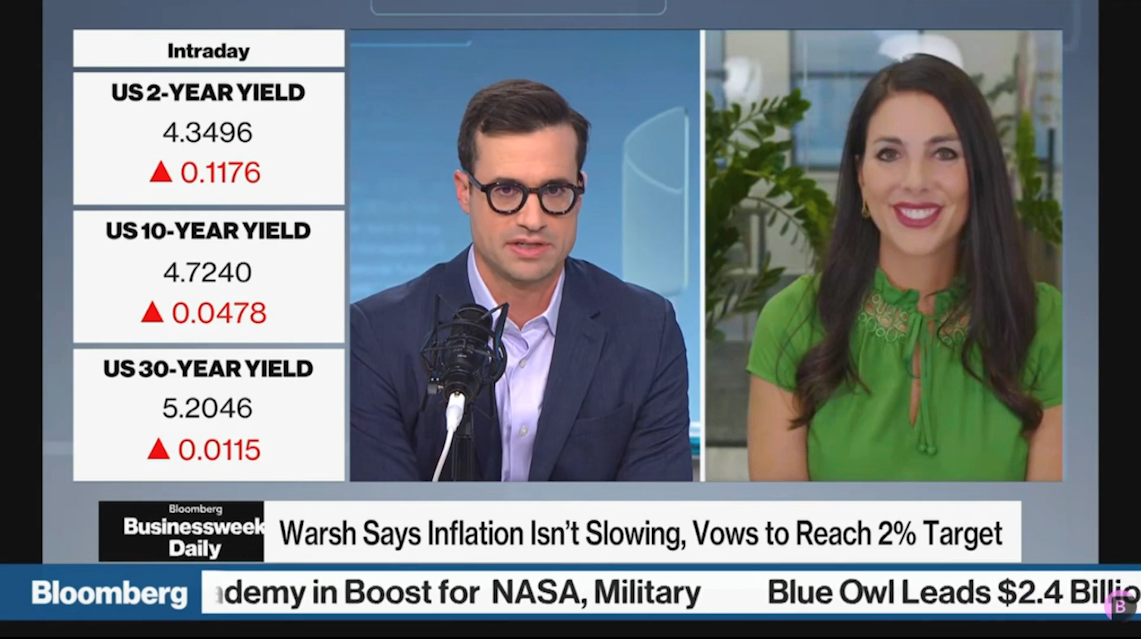
Brooke joined Bloomberg Radio: Businessweek to discuss why we’re maintaining a wait-and-see approach as markets weigh another possible rate hike following Fed Chair Kevin Warsh’s comments at Jackson Hole.
Transcript:
Well, we do stay on Jackson Hole. Not necessarily in Jackson Hole because that is what traders and investors are focusing on today. For more on policy, we’re joined by Brooke May, managing partner at Evans May Wealth, she joins us from Carmel, Indiana. Brooke, good to have you back on the program.
Are you making any changes to client portfolios as a result of what you heard from the Fed chair today?
You know, we saw what happened to bond yields today, especially at the front end. We’re seeing some pressure on tech stocks over concerns about rates moving higher. Are you making any changes to client portfolios as a result of what you heard from the Fed chair today?
Brooke: Good afternoon, Tim. You know, right now we’re not making any changes. We’re going to be in a wait-and-see right now. We’re pricing in about a 60% probability of a rate hike in September, and even higher probability of a rate hike before year end.
So, it’s not imminent at this point. Odds went up today based on, based on Warsh’s comments. However, I think that we’ve got a lot of good momentum across the market, not only in large cap, but also in small cap and international. And so, I think that you can continue to be an equity investor. However, certain areas of the market that are a little bit more interest rate sensitive, those that rely on debt, like small cap 40% to 50% of the debt small cap companies have is floating rate.
So, it’s something to watch if we do get a rate hike. I think that paring back certain areas would be would be warranted.
Are you convinced that policymakers are going to return inflation to that 2% goal?
Lisa: Brooke, I have to ask you, Warsh reiterated that policymakers are going to return inflation to that 2% goal. After hearing everything you said, I mean, are you convinced?
Brooke: No.
Lisa: That was quick. We need more from you, Brooke. This is TV and radio.
Brooke: You know, I think that, you know, it’s it’s hard to move rates. You know, if if it was easy to get there, we would have been there by now. We’ve been battling inflation now for several years. The fact that we’ve got now labor market stability is nice. However, I don’t know that, we’ve really made it much in the way of progress, especially with what’s going on in the Middle East.
Oil prices are playing a role and it’s rippling through to the rest of the economy. And so, until we see resolution there, I don’t know that we’re going to see a meaningful decline in interest rates. So yes, ideally we will get there. We might end up settling around 2.5% instead of the 2% that would be ideal. But, you know, Warsh did indicate that inflation is a concern and that they’ve got work to do.
Is inflation a concern until there is a total resolution out of the Middle East?
Tim: Is it a concern until there is a total resolution out of the Middle East?
Brooke: Yeah, I think so. I think the, you know, we’re going to continue to have uncertainty. And we’ve seen that if you look at gold and Bitcoin, there’s concern right now around the debasement of the dollar and what that would do for purchasing power. And rates are going to stay elevated if inflation is elevated. And so, I think it’s going to continue to be a concern as long as we’ve got uncertainty in the Middle East.
Nvidia shares are down 4% right now, but they added $442 billion to its market value on Thursday. What is that telling you?
Lisa: All right, Brooke, I want to switch over to, to tech and to AI and to that trade. Got to talk about the Nasdaq. It was lower for, it’s still lower now.
Then, we go to Nvidia shares. Nvidia shares right now they’re down about 4%. So, quite a difference from what we’ve seen, right? Nvidia added $442 billion to its market value on Thursday. All this said, I mean, what is that telling you?
Brooke: Earnings are, earnings are strong. And the the AI trend is real. When we look at Nvidia, you know, they’re expecting to have 72% to 73% profit margins next year. That’s incredible for a company their size that’s growing at the pace that they are.
And it says they’ve got pricing power. They’ve got demand and they’re broadening their customer base. There’s been a lot of publicity around, circular financing and some of the debt instruments that are going to be out there to allow them to serve more customers.
So, not just the hyperscalers, but now the neo clouds and other and other, other customers. So, we think that demand is real and that we’re going to see AI-related earnings continue to be very strong for a prolonged period of time.
What’s your take on why Nvidia shares are lower?
Lisa: So, what’s your take on why you think the shares are lower? Sorry, I didn’t mean to jump on you.
Brooke: Oh no, that’s alright. They, you know, we had such a surge after their earnings announcement. I think that there’s probably a little bit of profit taking there. I don’t think that there’s anything systemic that’s a concern right now. It could be somewhat interest rate related, but I think the overall momentum is very strong and earnings are going to be very strong going into 2027.
What is the next catalyst that we should be on the lookout for?
Tim: Yeah, I mean we’re we’re at the tail end of of, you know, third quarter earnings season, or second quarter, I should say. We’re into the third quarter. We will start to hear from some of the, you know, big companies in the beginning of, October. Given that we heard from the Fed chair today, Nvidia is behind us. We have a policy meeting in the middle of next month. Between now and then, what is the next catalyst that we should be on the lookout for?
Brooke: I think it will be midterm elections.
Tim: Really? You’re already, you’re already looking in November?
Brooke: Yeah. There’s not a lot there’s not a lot between now and then. You know, tends to be the unforeseen that gets you. But, you know, really on our on the horizon, right now would be midterm elections and what potential policy initiatives could come about through through the results.
Where do you think the next wave of investors will come from?
Lisa: And, Brooke, where do you think the next wave of investors will come from?
Brooke: Can you say that again?
Lisa: Where do you think the next wave of investors will come from? Because we’ve been talking about AI and tech, and where’s the next wave come from?
Brooke: I think the cash on the sidelines, you know, there’s a lot of FOMO out there. A lot of people have missed this rally, and there’s $7 trillion right now in cash and money markets on the sidelines. That money, you know, at some point will be redeployed into the market. And those that have been waiting for a pullback have really missed out. So, I think that continued good earnings momentum will push some of that cash into the market. And that could be another catalyst for a leg up.
Does the cash pile keep growing or does it eventually deplete in the near term?
Tim: That cash pile, though, Brooke, has just grown over the last six years. And I’m wondering, you know, we’ve been waiting for it to get on the sidelines. Does it keep growing or does it eventually deplete in the near term?
Brooke: It could keep growing. But I do think that there’s tremendous opportunity with earnings being this strong to get a better return for investors. And so I wouldn’t expect it to grow at the same pace that it has. It’s frankly shocking that it’s grown to the level that it’s at right now.
Tim: Yeah, it’s it’s remarkable. I mean, every time we see another trillion dollars added to it, I’m just like, you know, what is, where is this cash coming from and why is it not being deployed in any of the equity market or the bond market?
On the fixed income side, what is attractive to you?
Tim: Hey, we only have 30s left. On the fixed income side, what is attractive to you?
Brooke: We continue to like investment grade, as well as right now you could buy high yield. We don’t think there’s a lot of systemic risk right now in the system. And we think that you can pick up a little bit more yield without taking a tremendous amount of risk.
Tim: Brooke May, Managing Partner over at Evans May Wealth, joining us from Carmel, Indiana.