A client told us they were “conservative.”
But when markets dropped during COVID, they didn’t sell a single share.
They didn’t panic, but their portfolio was still sitting nearly 50% in bonds.
We see this contradiction often: portfolios being built around a framework, instead of around the person.
Once we realigned their portfolio to reflect their actual behavior and long-term goals, that shift contributed to ~$2M in additional portfolio growth.
If you’re a high-net-worth family and you’re still getting suboptimal performance, it’s worth asking whether your portfolio truly matches your needs.
Watch the latest episode of Lizzie’s Wealth Wisdoms for a breakdown of other patterns we see holding back portfolios at this level of wealth. ⬇️
Transcript:
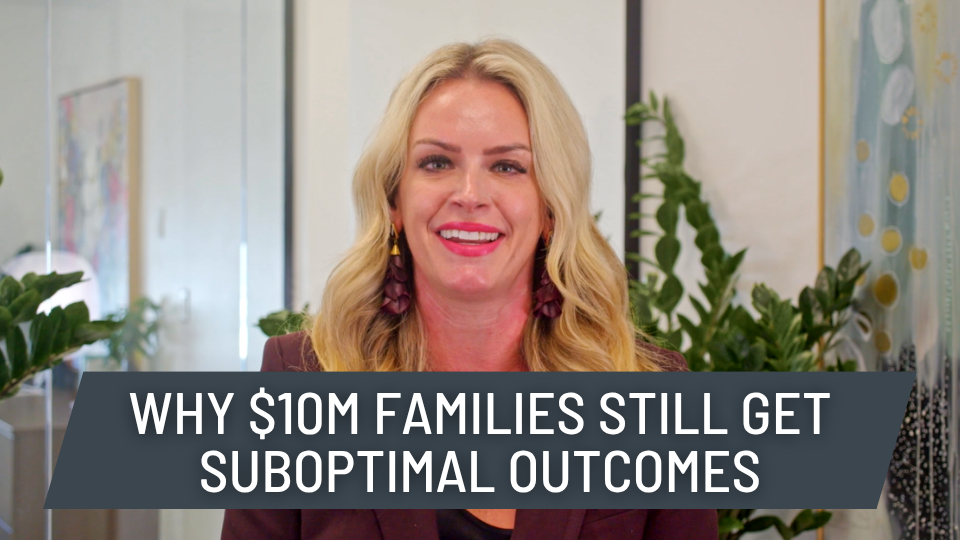
Welcome back to Lizzie’s Wealth Wisdoms. Today, I want to talk about something that might feel a little counterintuitive: Why many families with $5 million to $25 million still end up with suboptimal financial outcomes. Not because they made bad decisions, but because their strategy was never designed specifically for them.
Here’s the reality. Most wealth in this range is managed using:
1) model portfolios
2) standard asset allocations
3) fragmented advice across multiple professionals
And while those tools are efficient, they are not personalized. They are designed to fit a category and really not to optimize your life.
Issue #1: Managing to Risk Instead of Managing to an Outcome
The biggest mistake I see is this: managing to risk instead of managing to an outcome. So, let me explain. A model portfolio might say that you are a moderate investor and therefore should have a 60/40 asset allocation.
And on the surface, that sounds reasonable. But here is what often gets missed. The 60/40 portfolio is not built around you. It’s built around a general idea of how a moderate investor should behave. It assumes a certain level of volatility tolerance, a certain time horizon, and a certain pattern of withdrawals.
But it doesn’t actually ask:
- What are you spending each year?
- How flexible is that spending?
- What are your tax constraints?
- What did you actually do the last time that markets declined 20% to 30%?
And this isn’t theoretical. We see this all the time.
Case Study #1:
We worked with a family who came to us with about $23 million invested in a bank model. On paper, everything looked fine. But when we dug in, we realized that they were generating over $400,000 per year in taxable income from bond funds and dividends, most of which they didn’t even need.
By restructuring the portfolio to be more tax-aware and importantly, aligning their assets by account type, we were able to significantly reduce that unnecessary income. That translated to roughly $120,000 to $160,000 per year in tax savings, without increasing any risk.
And here’s where it gets even more important. The “40” in the 60/40 portfolio, the bond allocation, is used to serve a very specific purpose.
It was designed to provide income, to reduce volatility, and to act as a buffer when equities declined. But the reality today is the role of bonds has changed. So, when a high-net-worth family is placed into the standard 60/40 portfolio, the question becomes: Is that allocation truly serving your goals or is it just fitting a framework?
Case Study #2:
We saw this with another client, about a $30 million portfolio, who was sitting nearly 50% in fixed income or bonds.
They told us that they were “conservative.” But when we asked what they actually did during COVID, they stayed fully invested. No selling, no panic. So, the portfolio didn’t match their behavior. It matched a questionnaire that they had filled out.
We gradually repositioned the portfolio to better reflect their true risk tolerance and their long-term objectives. Over the following years, that shift contributed to $2 million of additional portfolio growth, simply by being more appropriately allocated.
Because for many families in this range:
- You may not need income from the portfolio
- You may have other sources of stability
- You may have a long time horizon
Or, you may need more flexibility, not just “bonds for safety.”
Issue #2: Taxes Are Not a Line Item. Taxes Are a Strategy.
The second issue is taxes. At this level of wealth, taxes are not a line item. They are a strategy. Yet most portfolios are:
- Rebalanced without tax awareness
- Positioned without regard to income versus capital gains
- Disconnected from the client’s broader financial plan
Case Study #3:
We recently reviewed a portfolio for a family with just over $10 million in investable assets that have systematically been rebalanced every quarter. That sounds disciplined, right?
But over time, that created ~$300,000 to $400,000 in realized gains, with no coordination around timing, tax brackets, or offsetting strategies.
When we stepped in, we were able to restructure the approach—harvesting losses when appropriate and being more intentional about when gains were realized. The result was meaningful. This was a six-figure tax deferral opportunity, while preserving capital that would have otherwise gone to pay taxes prematurely.
Issue #3: Lifestyle Expansion Without a Framework
And third, this is the one we’re seeing the most right now: Lifestyle expansion without a framework.
So, when markets perform well, spending increases. More travel, more gifting, larger commitments. And again, none of this is inherently wrong. But without a coordinated plan, families can unintentionally move from “financially independent” to “market dependent.”
Takeaway:
So, what should be happening instead? At this level, planning should be:
- Fully integrated across investments, tax and estate planning
- Customized at the account level, not at the portfolio level
- Continuously aligned with your actual life decisions
Because the goal is not just to grow your wealth. The goal is to use it intentionally, tax-efficiently, and sustainably. If you’re in this range and your strategy feels generic or cookie cutter, it’s worth asking: “Is my plan built for someone like me, or is it built for me?”
Because at this level, small inefficiencies don’t stay small. They compound into millions over time.
Thanks so much for listening. I’ll see you next time on Lizzie’s Wealth Wisdoms.