
Tuesday’s midterm election delivered a larger-than-expected shift toward Democrats, who won majorities in both the House and Senate, setting up divided government for the remainder of President Trump’s term.
Democrats also won several governorships previously held by Republicans, including Texas, Ohio, Georgia, and Nevada, and gained unified control of Pennsylvania’s state government.1
While a Democratic majority in the House was widely anticipated, the extent of the gains in the Senate and several traditionally Republican states exceeded expectations. Financial markets have responded with sizable moves in both directions on Wednesday (S&P 500 +1.58%) and Thursday (S&P 500 -4.36%), and the Volatility Index (VIX) spiked (+57%) over the two-day trading period.
Volatility In Perspective
Volatility is a normal part of investing, and midterm election years have historically experienced meaningful market swings. Across the 19 midterm years from 1950 through 2022, the S&P 500’s median intra-year pullback was 15.6%. The median return over the following year, measured from each year’s low, was 37.5%.2 While the lows are identifiable only in hindsight, they do, however, provide perspective on the importance of maintaining a long-term investment approach.
S&P 500 INDEX AVERAGE QUARTERLY RETURNS BEFORE, DURING AND AFTER MIDTERM ELECTIONS VS. NON-MIDTERM ELECTION PERIODS
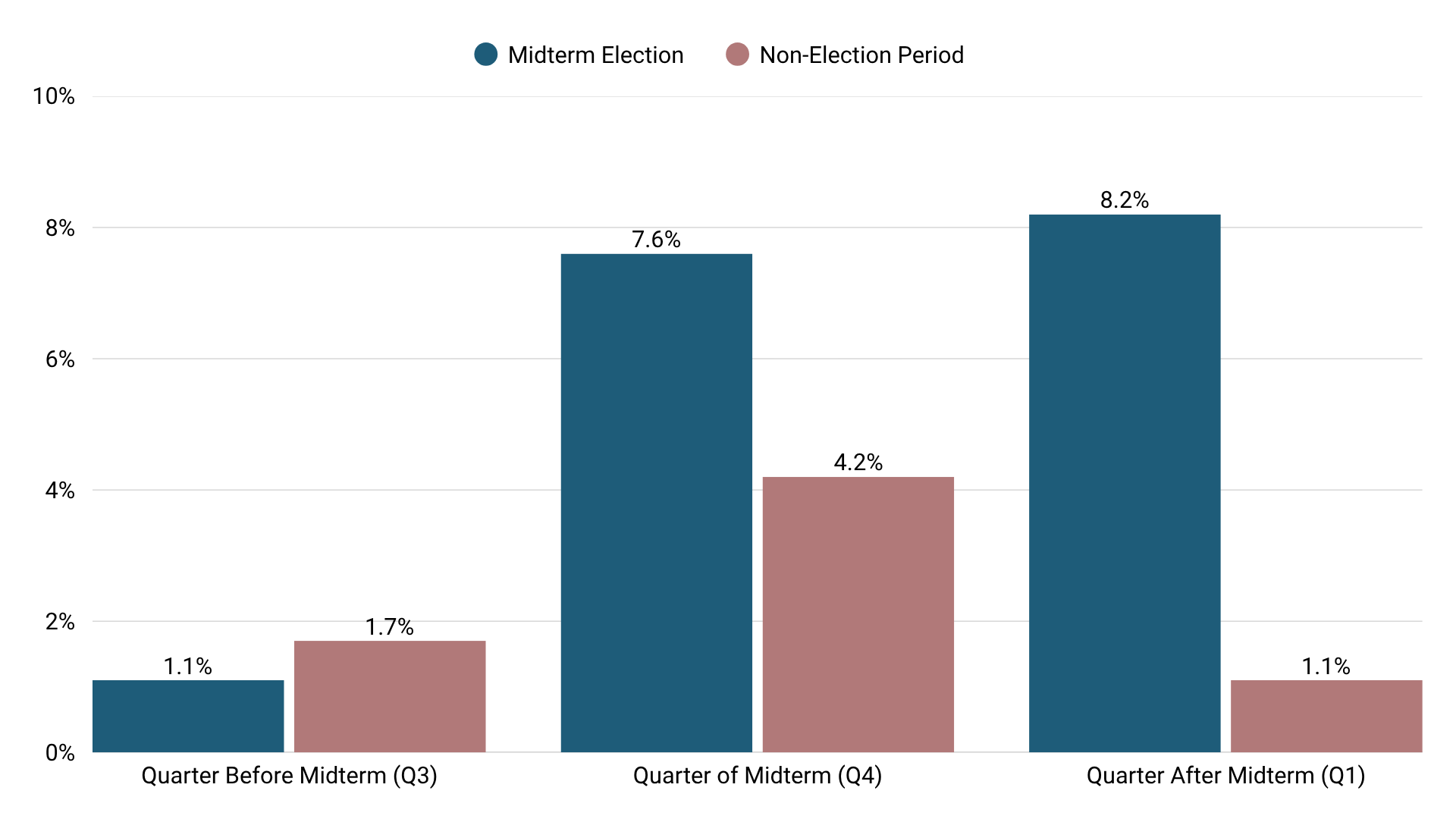
Source: First Trust, Bloomberg, Data from 1950-2025.
The sharp swings following this election illustrate how quickly investors can reassess the same information. Historical data shows that election-related volatility often moderates within 7 to 8 trading days as uncertainty recedes.3
Policy Changes Matter At Every Level
At the federal level, we are watching upcoming negotiations to extend government funding and raise the debt limit by next fall. Democrats will likely use these deadlines to seek policy changes, potentially including limits on U.S. involvement in the war with Iran, selected tariff rollbacks, reversals of spending cuts, and expanded health benefits.
The first deadline is December 11, when government funding is set to expire. Given ongoing disagreements, a short-term extension into the first quarter of 2027 appears most likely. However, Democrats could seek concessions before formally taking control of Congress in January.
At the state and local levels, our attention is on potential changes to data center development. As of November 4, 42 of 45 local ballot measures restricting data centers had passed or were leaning toward passage.4 Several incoming officials also campaigned on temporary development pauses or tighter requirements around electricity costs, water use, and permitting.5
States facing potentially tighter restrictions account for approximately 45% of planned U.S. data center capacity expansion, including roughly 25% in Texas.6 These figures represent exposure to possible restrictions—not projects already canceled.
The Bureau of Economic Analysis (BEA) estimates that AI-related investment in data center equipment and software contributed to 75% of the GDP growth in Q1 2026. Investment in data centers and related technology supports construction, equipment spending, and demand for power. Prolonged delays could temper economic growth and affect earnings expectations across parts of the technology, power, and industrial sectors. The impact will depend on the duration and scope of any restrictions, treatment of projects already underway, and whether investment moves to other locations.
Clear, workable regulation could help establish a more predictable development process. A more measured pace of investment could also ease capital spending demands and support free cash flow at some large technology companies.7 We are evaluating these potential benefits alongside the risks to infrastructure spending.
Where Do We Go From Here?
Markets may remain sensitive to headlines, especially over the next several trading days, as politicians continue to create headlines. Beyond that, we believe economic growth and corporate earnings will remain resilient, and will, ultimately, matter more than the initial election headlines.
Periods of volatility reinforce the importance of a balanced, diversified portfolio with a focus on high-quality companies.
As always, we will continue to evaluate whether policy changes alter long-term earnings potential and economic outlook and make adjustments as necessary.
Download a PDF version here.
1 Goldman Sachs
2 First Trust
3 Macro Bond
4 J.P. Morgan
5 J.P. Morgan
6 Goldman Sachs
7 Yardeni Research
Sanctuary Wealth makes no representation as to the accuracy or completeness of information contained herein. Any forward-looking statements are based on assumptions, may not materialize, and are subject to change without notice. The information is based upon data available to the public and is not an offer to sell or solicitation of offers to buy any securities mentioned herein. Any investment discussed may not be suitable for all investors. Investors must make their own decisions based on their specific investment objectives and financial circumstances. Investments are subject to risk, including but not limited to market and interest rate fluctuations. Any performance data represents past performance which is no guarantee of future results. Prices/yields/figures mentioned herein are as of the date noted unless indicated otherwise. All figures subject to market fluctuation and change. Additional information available upon request.