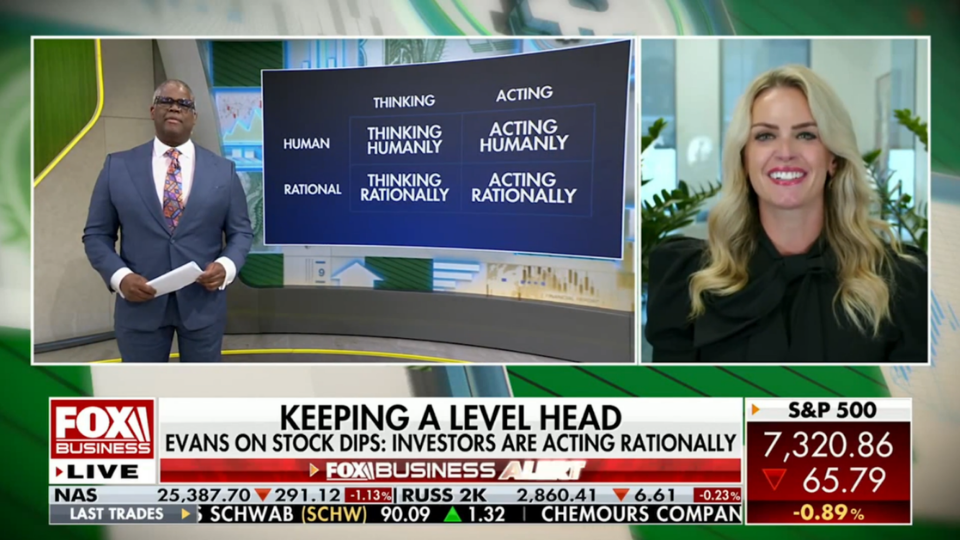

“Equity markets do not die because valuations are high. They die when earnings miss, the Fed gets aggressively restrictive, or liquidity dries up.”
Bank of America’s Sell Side Indicator recently flashed, and other measures suggest investor exuberance is building.
For some, that’s a signal to head for the exits, but Lizzie sees it differently.
Earnings continue to grow. The economy is expanding, albeit slowly. And the labor market remains resilient.
From our standpoint, the conditions that typically end a bull market don’t exist today. Check out Lizzie’s Fox Business Network interview with Charles Payne below for more insights 👇
Transcript:
Why is it not such a bad thing to see red in the last few sessions?
Charles: My next guest says that Friday’s sell-off, it was really scary. Tuesday’s, you know, sort of tremors were also worrisome. But here it is all put together, evidence, actually, that investors are acting rationally. I want to bring in Evans May Wealth Managing Partner Elizabeth Evans.
All right. So, I love the way you framed this. Explain it to the audience why this may not be such a bad thing to see the red in the last few sessions.
Elizabeth: Well, good afternoon, Charles. The last few trading days certainly aren’t fun as an investor. But if you think about the parabolic move we’ve had since the March 30th lows, this is a healthy and natural digestion for the equity markets to move higher.
So, we saw good jobs report on Friday. We’re back to a “good news is bad news” environment for the market. 2-year Treasury yield rose sharply to 4.17%. And now the market’s pricing in rate hikes this year and two next year. But if you take a step back, earnings are growing. The economy is growing, albeit at a slower pace.
And the labor market is hanging in there.
Signals suggest we’re too close to the peak. Where do you stand?
Charles: Let me, in your note you also referenced Bank of America. They put out a bunch of charts saying, hey, maybe this is it. This is one I talked about yesterday. Of all the red flags that they’ve checked, in March, they had 40% of them were checked, in April, 60, 50% were checked. Now we’re up to 70%. And a lot of people are saying, okay, that’s it. We’re too close to the peak. Where do you stand?
Elizabeth: Yeah, so their sell side indicator flashed last week. So now we’re in the midst of that pullback. And Goldman issued something similar showing that we’re in the 88th percentile from a market condition, one of exuberance.
So, not yet one of irrational exuberance, but exuberance, nonetheless. From my standpoint, equity markets do not die because valuations are high. They die when you have earnings misses, when you have an aggressively restrictive Fed, or liquidity dries up. And none of those conditions exist today. In fact, what’s driven the market higher is earnings growth.
Semiconductor pullback? You’re still bullish, how do you explain that to your clients?
Charles: I know you know, you caught you know you I, when I saw your note saying that semis could pull back as much as 30%, that would take the stocks down below 10,000.
But you’re still bullish. How do you explain that to your clients? Like, hey, we’re going to hold on, and we may hit one heck of an air pocket, but we’re going to stay the course.
Elizabeth: Yeah, it’s a it’s a tough one. So, number one, you have to remember since March 30th, the semi index, a week ago it hit its peak up 80% in less than, two-and-a-half-month period of time.
So always to kind of take a step back. But if you look at the technicals, we’re about 10% into a pullback. I do think you could see a 20 to 30% pullback. But for any investor who is underweight semis this is an opportunity to add to your portfolio. And we continue to believe that we are in a long-term secular bull market driven by AI and innovation. And semis will lead us higher.
Stock picks:
IBM
Charles: Elizabeth, you’ve got three stocks. We got a minute and a half. So, let’s kind of hit them real quick. But IBM, a lot of folks have kind of jumped on the IBM bandwagon. But, you know, we’re going to pull up the chart here in a second. We’ve got it. But, you know, it seems like this last earnings report, which I didn’t think was bad. It hasn’t been able to regain its equilibrium. Why do you think it gets back higher, it goes back higher from here?
Elizabeth: Yeah, a blast from the past. This, they’re really emerging as the premier enterprise platform provider. So, their competitive advantage is the deep existing relationships that they already have with these large enterprises, and they are neutral as a relates to AI vendors. So, they’re able to integrate AI into the existing tech stack, which I think is so important as these large institutions move from experimenting to, to full AI adoption.
Vistra
Charles: Vistra was trading with, with the tech sector. Everything stalled in October. Of course, technology’s come back up. Vistra keeps drifting lower. You like it here?
Elizabeth: Can you believe, Charles, the performance year-to-date? I’m just shocked it hasn’t done better. This is a story on power for AI data centers, domestic manufacturing. They have 6.4GW of nuclear power generation, and half of that is not spoken for. So, I do think I’m surprised at the year-to-date performance. But I think there’s upside from here.
Celestica
Charles: Surprised and frustrated. That’s not the only one. Listen, 20s, just real quick. Celestica is a name that some folks have talked about. It’s, it’s done remarkably well. Why do you like it?
Elizabeth: So, Celestica is 23% off its 52-week high. If you think about the data center build-out, we need so much more than the Nvidia chips. We need the servers, the networking equipment, the power supply. The EPS growth estimates for it being 23% off its 52-week high, earnings are expected to be up 69% over the next 12 months, annualizing 45% over the next 3 to 5 years.
Charles: Yeah. And, you know, and it’s right there at the 50-day, folks. It doesn’t look like it’s off as much as she’s saying. But it is. And that just underscores maybe volatility but also upside potential. Elizabeth thank you very much. Always great seeing you.
Elizabeth: Thank you, Charles.