
2026 looks promising for equity markets. While the labor market may be slowing, there are 4 strong tailwinds going into the new year ⬇️
📊 GDP growth remains resilient
🏛️ The One Big Beautiful Bill Act is stimulative to the economy
✂️ Interest rate cuts will likely continue
📈 Earnings breadth and growth outside of the Magnificent 7 continues
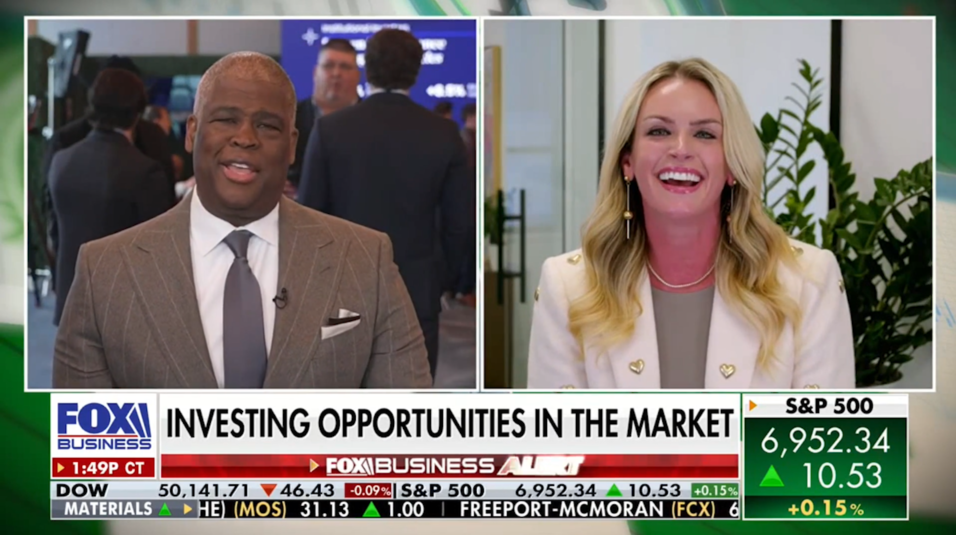
And we are already seeing meaningful productivity gains in the workforce, likely due to AI. This can potentially offset any further softening in the labor market. Watch Lizzie’s Fox interview with Charles Payne to learn more! ⬇️
Transcript:
All right, folks. Now, my next guest says that the outlook for next year, 2026, is actually promising. So, let’s bring in Evans May Wealth managing partner, Elizabeth Evans. So, Elizabeth, your note says that you see next year’s promising but—or, despite, rather—a weak labor market. And I guess, considering that the consumer is two-thirds the economy, sometimes people ask: how can they coexist?
How can you have a strong stock market and a weak consumer?
Well, good afternoon, Charles. We do think that 2026, the setup is very good. So, why is that? So, first of all, if you look at GDP expectations. So, real GDP growth in 2026 is expected to be up 2%. So, through the third quarter, if you look at the Atlanta Fed GDPNow model, we’re actually tracking right at 3.5%. So, that is a deceleration from where we are.
But there is some pull-forward as a result of the One Big Beautiful Bill, capital investment with IP and equipment. So, you have a strong economic setup. Any overhang, any impact of tariffs in 2025 is fading in 2026. You also, the fiscal policy vis-a-vis the One Big Beautiful Bill should be stimulative to the economy in 2026.
And the last two I think are the most important. Number one, we have entered a rate cutting cycle. So, the market is so worried about the pace of rate cuts. But what we have to remember is we are in a rate cutting cycle after an eight-month hiatus. And as you just discussed with your prior guest, we in the first part of the year are going to have a new fed chair, which could bring us to a neutral rate more quickly.
And you have earnings, both earnings breadth and earnings growth in the other 493 names. As long as the Magnificent Seven can hang in there, that paints a very rosy picture for equities to continue to move higher in 2026.
And so, you expect them to, you know, the Mag Seven to do its thing but not, of course, like it’s done. As long as it doesn’t collapse because you like some rotation here.
And you say SMID, small and mid-caps. That’s the place to be.
Well, I would say we are still, we’re still not on the rotation wagon just yet. However, this is a part of the market that we’re looking at very closely. So, if you look at the small and mid-cap names that have performed well year-to-date, it’s actually been the lower quality names.
You’ve started to see a little bit of a reversal beginning in October. So, we want, we are like you Charles, fundamental investors. So, we want to see high quality to continue to outperform. And typically, with small and mid-cap you need to have job growth. And you need to have ISM manufacturing really heating up. So right now, those two are trending in the right direction.
But this is a part of the market that we’re watching really closely. And I could easily see us adding to in 2026. It’s still a little early for us.
Okay. All right. Cool. I misinterpreted the note.
Let’s talk about words you like here. And of course I got to start with Broadcom. Really, outside of Google, the darling of the sector until a couple of weeks ago when they reported. I thought it was an amazing number. I haven’t sold or told my subscribers to sell. I like the fact that it’s rebounding today.
How much does it bother you though, that [Broadcom] sort of took that hit? And why are you still so confident?
Really, the report a week ago was an amazing report. And now I think right now it’s down 18.5% since a week ago. So, you know, I think that investors are really missing, they’re so focused on the short-term margin noise. And they are missing the bigger point that Broadcom, or AVGO, is the premier in custom silicon. And they are really enabling low-cost AI inference at a broad scale, which is so important as these hyperscalers move away from training to inference.
So, this is a great opportunity, if you’ve missed it, to get in at a more attractive entry point. And we still believe it’ll be one of the winners and durable AI infrastructure.
I believe you 1,000%. I’m in there with you. Hey, less than 30s though. Got to ask about gold (GLD). Obviously, has had a monumental move.
How does that sustain? Is it all about worldwide debt, debt, debt, debt and really the currency and all of those sorts of things?
I think the primary reason that the data goes higher from here is that it is under-owned. So, if you look at private financial portfolios, right now, gold, despite being the best performing asset class this year, there’s only an allocation of 0.17%.
And the broader, if you look at large institutions, half of large institutions don’t hold gold, and those that do hold less than half a percent. So, Goldman did a super interesting report that looked at if allocation increases by one basis point, 0.01%, that should drive gold prices higher by 1.4%. So, Charles, in a universe, a $112 trillion portfolio universe, even a modest shift for the purposes of diversification will drive prices higher.
Yeah. And one thing about it: the higher it goes, the more appetizing it’s going to become for a lot of people. Great stuff, Elizabeth. Thank you very much. Merry Christmas.
Thank you, Charles. Merry Christmas.