Markets can be confusing right now. Strong earnings aren’t fully reflected in the S&P 500. Why?
Much of the growth was already priced in following last year’s stellar performance. But the story is still improving beneath the surface.
International stocks and small caps are participating again, signaling a more balanced market.
Market breadth is broadening and diversified investors are being rewarded again.
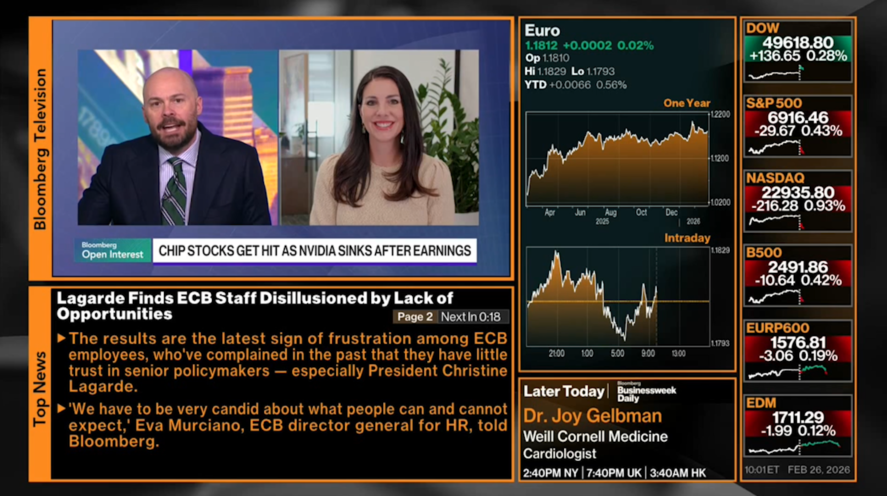
Watch Brooke May’s Bloomberg interview for more market insights! 👇
Transcript:
Joining us now is Brooke May, Evans May Wealth Managing Partner. She is a shareholder in Nvidia. And Brooke, you know, I was talking to Danny about this earlier. Like everybody is a shareholder in Nvidia, right? If you own this market, you own Nvidia. It’s a big piece of the S&P, a bigger piece of the Nasdaq. What’s going on here with the shares?
Nvidia: Why are they selling off after what our own tech analyst Mandeep Singh was a stunning earnings report?
Good morning, Matt. Agreed. You know, I thought the earnings report was outstanding. So, this muted reaction really is just a reflection of the fact that the earnings were priced to perfection. You know, not only did they beat on revenue they also beat on earnings.
And earnings growth was up 82% year-over-year. Revenue growth was up 73% year-over-year. And they’re doing it with 75% profit margins. As we know, though, right now this is an environment that’s really focused on guidance. And they guided well. You know, they’re going to maintain those 75% profit margins and grow revenue from $68 billion to $78 billion.
That’s the kind of company I want to own. So really right now, it’s just a matter of the fact that they were priced to perfection.
So, when you see a decline like this of nearing 4% this morning, Brooke, is it time to back up the truck?
You know, it’s our largest holding in our growth strategy. We own about 11% to 12% in our growth program. And we’re going to keep that allocation, you know, near-term. You know, we might see some volatility as there’s concern around CapEx or with AI spending. However, they’re expected to grow earnings about 40% a year over the next three years. And if it’s trading at about 40 times forward earnings, that 1 to 1 ratio is very attractive.
So, we’re not concerned at all about the valuation. And it’s not a stock that we want to pare back.
But this, Brooke, this is exactly my point. Like you and many other investors already have the truck full of Nvidia.
When you hit a speed bump, something’s going to fall out. So, you know, who’s the marginal buyer?
I think that, you know, you’ve missed the boat if you haven’t owned Nvidia. But you know they’re going to continue to grow their earnings. And so there will be demand there. But you’re right. It is a, it is a major holding in almost all growth strategies.
It does seem to be weird, Brooke, because on one side, we’re saying is this thing too highly valued? Is there a bubble on the price? And then on the other side, we’re saying Nvidia and all of its AI infrastructure world is so amazing and so incredible that it’s going to completely disrupt software.
So, if you believe in the future and the promise of AI, do you at the same time, logically in your head, need to also think, I can’t really own a lot of these software names then, too?
Software is a concern. You know, the big software players though aren’t going to go out of business. We’re just in a recalibration.
You know, they’re going to figure out how to partner with AI to continue to evolve. But that recalibration is going to take a minute. So, I don’t think that this is an entry point for software, and I do think there are going to be struggles. However, you know, those companies will reinvent themselves, continue to innovate, and, you know, they’re not going to go out of business.
There is concern, though, around, you know, AI CapEx spending. And I think it’s overblown. If these models continue to evolve, companies are going to continue to buy. In fact, you know, Nvidia is expecting sales to grow with Alphabet 100% over this next year, Meta up 75% and Amazon up 50%. So, there’s demand out there and they’ve got partnerships with just about every big tech company.
So, we think that, you know, there’s going to continue to be demand for AI chips, especially Nvidia chips.
What else do you do you like, Brooke, or what else do you have in your growth portfolio that isn’t AI, an AI company?
We own energy stocks. We also own industrials. So, you know, we really have a diversified growth strategy.
We feel like it’s not a great time to try to overweight or underweight certain sectors. But what’s really exciting is the breadth of this market. You know, we’ve seen Mag 7 earnings dominate the S&P 500. In fact, if you look back to 2023, three-quarters of the earnings in the S&P 500 came from the Mag 7.
This year, we think only about 50% of the earnings on the S&P are going to come from the Mag 7. So, clearly there’s greater participation. Other asset classes have come to the party. In fact, 60% of stocks in the S&P 500 have beaten the benchmark. And if you look at the top 25 performers year-to-date, not one is a Mag 7 company.
And you know, as we know, international and small-cap have been out of favor. Right now, they’re hot. International is up 10% year-to-date. Small-cap is up 7% year-to-date. And if you don’t own gold in the portfolio, you’ve missed out. So, you know, we’re back to traditional diversification and those investors being rewarded.
Even, so though, so, Brooke, if you don’t count Nvidia in yesterday’s earnings, companies in the S&P grew earnings by 13% in the fourth quarter. That’s almost six percentage points better than expected. Yet, in that period of time, the S&P fell 1.7%, JP, the data, if you take it from JP Morgan to Walmart, that’s tied for the worst performance during an earnings season in the past ten quarters.
Why aren’t earnings being better reflected in this index right now?
You know, it’s a product of the performance last year. You know, last year the second half of the year, you know, earnings expectations weren’t robust. But they were decent. You know, quarter-after-quarter we were expecting 7% to 8% earnings growth. And it was coming in double-digits.
And the market performed last year. We had stellar performance. So, this year’s returns or this year’s earnings growth was already priced in. We think, though, you know, the S&P could grow earnings 14% to 15% this year. But it’s going to take looking out to 2027 before, you know, we really see a meaningful move up in the market.
Are you hedged at all, Brooke? I mean, I know that this market’s been kind of flat for a few months now. But what do you buy for hedge?
Gold obviously has gone absolutely bonkers and Bitcoin has dropped. The VIX is at 20 I think but doesn’t look like a lot of people are buying volatility.
You know, we aren’t hedging the portfolio, we’re just participating with broad diversification. So, I guess if the risk is in the S&P 500, you know, adding that small cap, adding that international, adding gold to the portfolio allows us to participate in other areas ff the US large cap is going to be somewhat muted.
Brooke, thank you so much for joining us this morning. That’s Evans May Wealth Managing Partner Brooke May.