
All eyes are on the Fed tomorrow.
While we don’t expect a rate hike tomorrow, that might mean one in December. Inflation remains elevated, the labor market tells a more complicated story, and consumer confidence came in stronger than expected.
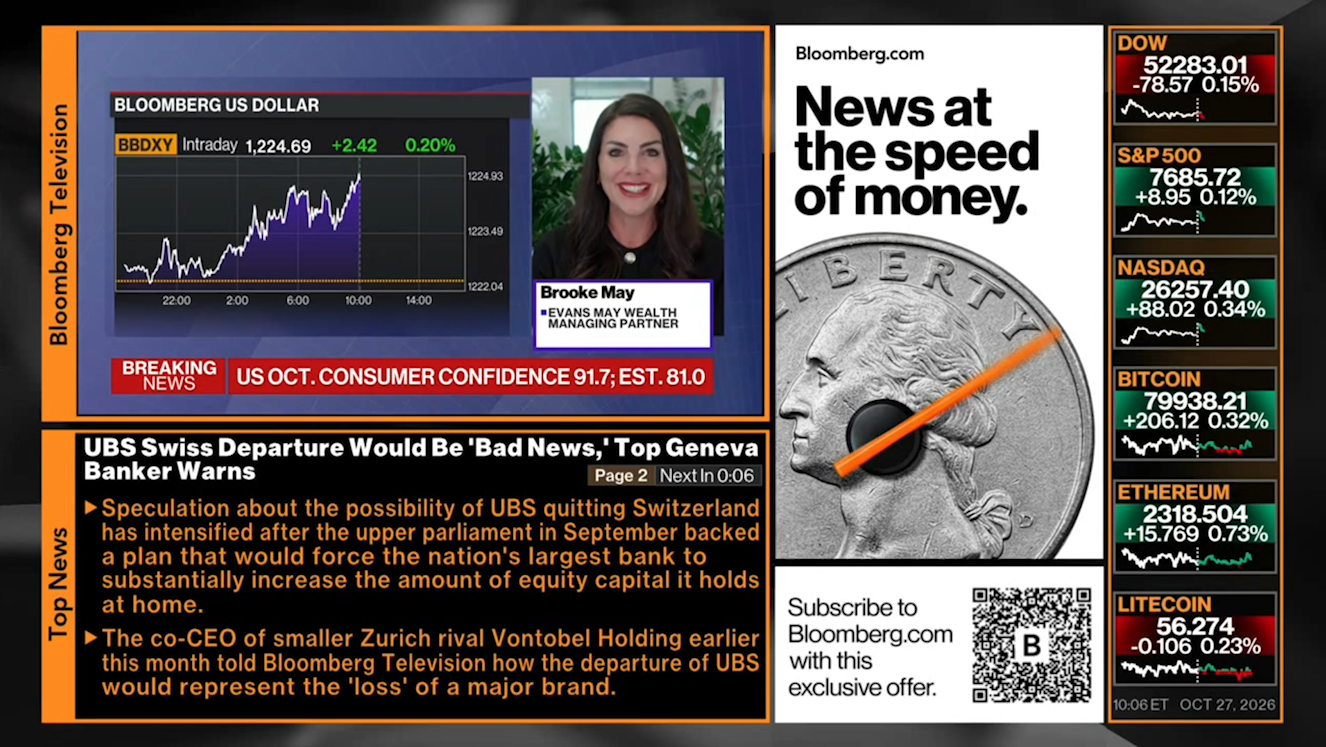
Watch Brooke’s Bloomberg interview below for more insights. 👇
Transcript:
Consumer confidence is rising, beating all estimates. Can you talk to us about that and what they may mean to the broader markets?
Isabelle: And joining us now for more is Brooke May, Evans May Wealth Managing Partner. Brooke, we just got consumer confidence rising, beating all estimates. Can you talk to us more about that and what that may mean to the broader markets?
Brooke: I love seeing consumer confidence come in so high. You know, there’s been a lot of pessimism out there. And so, it’s interesting because retail sales are coming in at 6.3%. But we know that wage growth is only 3%. And when you’ve got headline CPI at 3.7%, but wages only growing at 3%, you worry that the consumer is getting squeezed. And so, you know, seeing consumer confidence come in so strong, that’s appealing.
Do you think rising diesel prices are reflected in the core CPI and PCE numbers that we’re seeing that the Fed may be taking into account? And how do you incorporate that when you make market decisions?
Isabelle: And you do say that it takes a while for consumers to get squeezed. But we have been seeing also diesel prices really rising. And that will take time to filter to to filter through consumers. How do you make that? And do you think that’s reflected in the core CPI and PCE numbers that we are seeing that the Fed may be taking into account? And how do you also incorporate that when you make market decisions?
Brooke: Yeah, absolutely. You know, headline CPI at 3.7%. We’re seeing PPI though at 6.3%. And that’s the producer price index. Diesel prices at $7 a gallon and 65% of goods are are shipped by truck. So, it takes up to six months to see those prices flow through to consumers.
And so, you know, we’re we don’t think that we’re out of the woods yet. We think that it’s almost imminent that we’re going to see a rate hike in December and possibly future rate hikes to come. Even if we get a resolution in the Middle East, we do expect to see inflation continue to tick higher. We’re going to get PCE later this week, and I’m eager to see what that number is.
Do you think the risk of the Fed waiting to raise interest rates could be greater and detrimental to the market, especially with inflation still elevated?
Isabelle: Do you think the risk of the Fed waiting could be greater and could be detrimental to the market? I mean, there are also risks when it comes to maybe holding holding back when it comes to raising interest rates, especially with inflation still elevated.
Brooke: I don’t. Yeah, I do not think they should pause. I think that, yes, tomorrow we don’t expect a rate hike, but in December, I do think we need a rate hike. And then we’ll be data dependent after that.
You know, Warsh doesn’t give us a lot of guidance, similar to the Greenspan era where we see “greenspeak.” And, I think he’ll indicate that inflation is a concern, that they’re going to tackle inflation.
But, you know, the other part of their equation is the labor market. And the labor market has been strong. It’s been the backbone of the economy. Unemployment right now is only 4.2%. And we’ve seen unemployment under 4.5% now for five years. But that doesn’t tell the whole story.
You know, when we look at, when we look at, wage growth only at 3%, we’re in a slow-to-hire, slow-to-fire environment. And we know job switchers, those that leave their company and go elsewhere, they typically get about a 4.7% increase in compensation. However, job stayers only get about a 3.4% increase in compensation. So, whenever we look at wage growth, that’s not helping the scenario.
In addition to those that are out there looking, it’s very difficult right now to find employment.
What would you need to hear from Kevin Warsh to believe inflation is really on its way back down to 2%?
Isabelle: What exactly would you need to hear from Kevin Warsh to believe that inflation is really on its way back down to 2%, Brooke?
Brooke: I think he’d need to say it, you know, he would need to say that, you know, we’ve tackled inflation. You know, our job is almost done. But I don’t think he’s going to signal much. We would need to hear him actually say it. And I think that what he’s going to say is that inflation is a concern. That’s their priority, and that they’re going to do what they need to do to get prices under control.
Is there a number you’re going to focus on that would convince investors, including yourself, that the massive AI spending is going to pay off sooner rather than later?
Isabelle: And of course, this week we’re about to hear from Alphabet, Microsoft, Amazon, Meta. Any number that you’re going to be specifically focused on to really maybe convince investors, including yourself, that the massive AI spending that we’re seeing is going to pay off down the line sooner rather than later?
Brooke: Yeah. Yeah. We love the hyperscalers. We love a lot of the big tech names that that you mentioned. We definitely think you want exposure there, but we’re not overweighting those names any longer. For a long time, two-thirds, three-quarters of the S&P 500 earnings were coming from the Mag 7. And it’s a different environment right now.
We expect earnings growth this quarter to be almost 30%. But if you strip out some of those big names that have really carried earnings for the last few years, we’re still expecting to see 27% or 28% earnings growth.
And they’re doing it with really strong margins. We think that we could see margins around 15% this quarter, and it’s not an anomaly. We expect to see 15% plus margins for the next three quarters. So, this is the type of environment where you can have broad exposure to U.S. equities. Large cap, though. We’re keeping a close eye on small cap right now.
As we know, small cap is much more interest rate sensitive. A lot of their debt is variable. And so, if we see rates tick meaningfully higher, that could cut into small cap earnings. We haven’t pared our small cap exposure and year-to-date it’s done well. But it is something that we’re cautious in keeping an eye on.
What are your thoughts on AI adoption?
Isabelle: What about when it comes to AI adoption? We have Apollo’s Torsten Slok saying that AI investments has provided zero payoff to corporate America outside of technology.
Brooke: I disagree. Goldman had a report recently that indicated we’re seeing 20 to 30% productivity increase where companies are using AI. And so, there is there is evidence that AI is going to have an impact. Now, from a dollars and cents standpoint, you know, the math might not work right now.
We’re expecting to see almost $1 trillion in AI spend globally. And more than half of that is coming within the US. But I don’t think we’re in a bubble that’s about to burst. When we look at AI spend, there will be some winners and losers and the headlines whenever we see a company struggling or having overextended themselves with the AI build out, that will create volatility in the market.
But reality is, we’re nowhere near capacity when it comes to AI infrastructure. In fact, we’re seeing it double about every 12 to 16 months, and we’ve got a long way to go. So, there will be volatility in the near-term whenever we see disappointment among some of the neoclouds or others who have invested extensively in AI, if their business model doesn’t come to fruition.
But overall, in the broad market, those that are investing in AI, it’s going to pay off.
Isabelle: Definitely going to pay off. And we’ll be on the lookout this week when it comes to those earnings. Brooke May of Evans May Wealth, thank you so much for joining us.