The last few years have been a good reminder that you can’t time the market.
Nobody could’ve predicted we’d face a global pandemic or shifting tariff policies.
At the same time, we also saw significant technological innovation and businesses adapting and growing.
The better strategy is to stay consistent.
Because in the long run, it’s about time in the market, not timing the market.
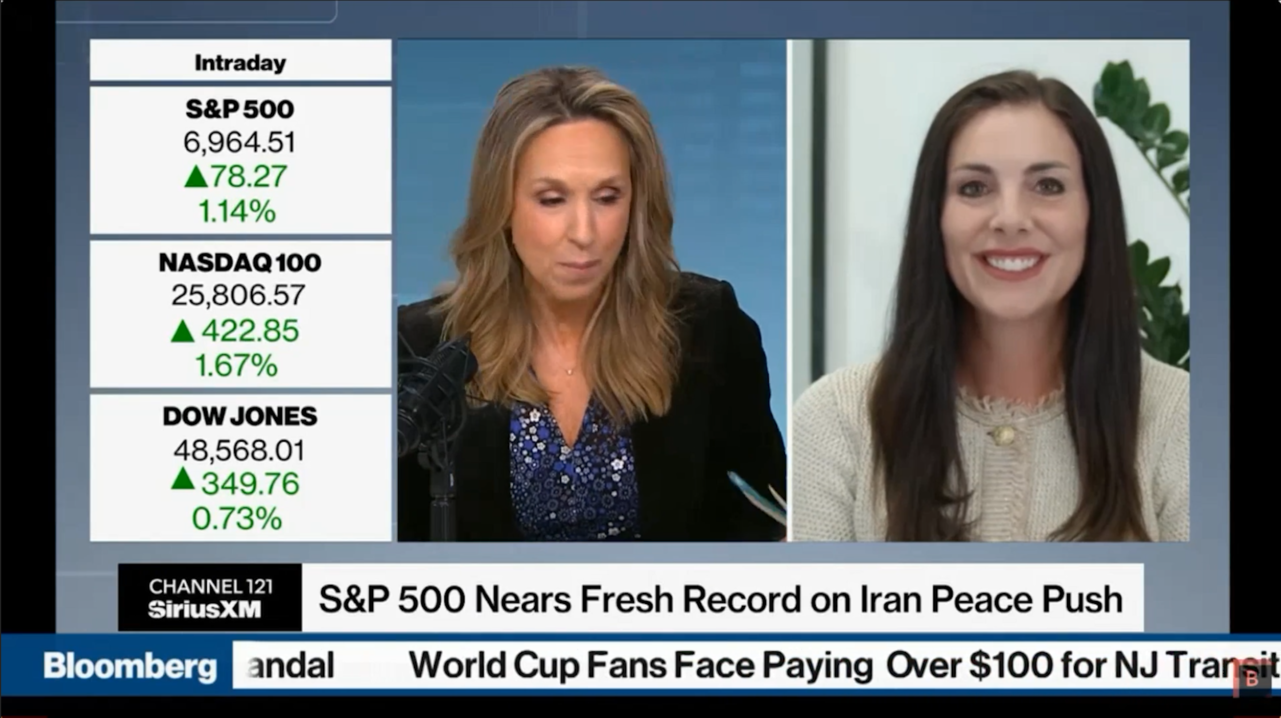
Watch Brooke May’s Bloomberg interview for more insights into how we’re navigating the current market environment. ⬇️
Transcript:
Tim: That’s the question. Brooke May is Managing Partner at Evans May Wealth. The firm has around $1.6 billion in assets under management. She joins us from Carmel, Indiana. Brooke, are markets getting ahead of themselves?
Are markets getting ahead of themselves?
Brooke: Hey, Tim, Good afternoon. I don’t think so. I think that, you know, we have a lot of optimism right now on what 2026 will entail, and you can’t let the headlines distract you.
Typically, when events like this occur, you’ll see a decline over 6 or 7 weeks, and then the market will recover over the next 6 or 7 weeks. And this recovery has been expedited. So, we’re not necessarily in the clear. However, this is a midterm election year. And so, we think that fiscal policy is going to be stimulative. And I think this administration has gotten the message that higher gas prices won’t bode well for this party come November. So, I wouldn’t be surprised if there’s a near-term resolution.
Carol: It’s almost like you read ahead in our show rundown, because at 4:20pm, we’re going to talk about the Electric Fury and basically soaring power bills threatening to swing U.S. elections come November.
Brooke, what can the administration really do about this?
Carol: Tell the hyperscalers, ‘stop building’? Like, what or ‘stop investing,’ which has been a big prop, on propping up of the financial markets that spend. So, I’m just curious what can really be done here?
Brooke: Regulation. There could be threat of regulation and punitive, you know, ramifications. In addition to that, they could require these tech companies that are utilizing these data centers to build them and pay for them themselves, supply their own power. But obviously, that would take quite a few years to build. But there might be a lot of rhetoric right now as if there’s a resolution to come.
Carol: So just accept it that, folks, this is how it’s going to be until we either build out alternative energy forces, build that out. And let’s assume that demand might start to taper off a little bit at some point. I mean, there’s a build, it’s a massive build, but we’ve all heard those, you know, conversations.
We’ve had them here that, you know, questions about how much more, like, do we see this AI build? At the moment it feels like a lot more, but nonetheless, time will tell.
How much more do we see this AI build?
Brooke: Yeah. You know, I don’t see a reduction in energy use. I think if anything, it’s only going to continue to ramp up. When you look last year, at businesses, 76% of businesses said they had adopted AI, which means there’s still quite a few left.
And a lot of these are just using it in its infancy. So, while there’s, you know, still not mass adoption, it’s still growing. We’re going to continue to see energy consumption demand increase.
Tim: Yeah. I mean, this is like Carol said, we’re going to spend about 12 minutes in our four, 4:00 hour talking about this with Josh Saul. It is the Bloomberg big take and one of the most read stories on the Bloomberg terminal. So do check it out.
Setting aside the politics of this and where it will prices will or will not be in the next few months. We are starting to hear from companies. Some of the big banks have reported results.
Are you starting to get concerned that consumers will start to feel the pinch as a result of this and pull back on spending?
Brooke: They will, but not significantly at this point. If we see oil increase above $5 a gallon or gas increase above $5 a gallon, we will start to probably see some ramifications. But when you look at credit card and debit card spending, it was actually up 4.3% year-over-year.
So yes, part of that is energy consumption. But people still feel pretty good about their environment. They won’t tell you that. Sentiment is poor, but they’re continuing to spend. And so, if people have jobs, they’re going to spend, and we don’t see that changing anytime soon, knowing what we know today.
What would you say to somebody, Brooke, at this point, who wants to put some new money to work?
Brooke: Right now, I’d say let’s dollar-cost average in. We’re hitting new highs. And there’s a tremendous amount of uncertainty right now. We’re optimistic. Don’t get me wrong. We think earnings are going to be really strong this year. But typically, in midterm election years there’s an average drawdown of about 18%.
Carol: Oh!
Brooke: And it’s tough to know what that trigger will be.
Carol: Yeah.
Tim: So, it hasn’t happened yet.
Brooke: Right. Surprise! Knowing that though, you know, I think it’d be prudent to dollar-cost average in. And if we get a 20% pullback, we can escalate or expedite that schedule. But I think it’s prudent right now, especially for a new investor to slowly work their funds in.
What do you think could [potentially] cause an 18% drawdown?
Carol: Wait. Can we go back to the 18%? What do you think will cause that? Economic slowdown? Inflationary pressures?
Tim: I mean it’s not guaranteed it’ll happen.
Carol: No, but you’re saying historically.
Brooke: That’s an average.
Carol: Yeah.
Tim: But there was already a drawdown of close to 10% this year that has recovered. So that could be. I don’t know. Is that it? I don’t know.
Tim: We’ll let you talk, Brooke.
Brooke: It tends to be what you don’t see coming that gets you. And, if anything, with this administration we’ve learned that it’s unpredictable. So, I think that for us to see that type of drawdown, it would either take an extreme escalation for what we’re seeing in the Middle East or something unforeseen that isn’t on our radar at this point in time.
Has the drawdown happened or is the drawdown coming?
Tim: Yeah. And then, look, nobody can answer this question, but I think what you’re referring to, Carol, is, has the drawdown happened yet or is the drawdown coming? Because we are in a midterm year.
Carol: Yeah. Are you saying that it hasn’t happened yet? Like what’s your view on it?
Brooke: I think that it’s unknown and it’s uncertain. You know, I think that it’s very difficult to time the market.
When I look and when I look back and, you know, I talk to clients and I say, okay, six years ago, if I would have told you we’re going to have a pandemic, we’re going to have tariffs, we’re going to have a lot of inflation, we’re going to have a few conflicts around the world that we’re involved in. You know, do you want to be invested? I think the resounding answer would have been, ‘no.’
So, it just goes to show that you can’t time it. And that the market can defy logic. U.S. businesses figure out how to make money in all different types of environments. And, you know, I don’t know that knowing what we know today, there’s anything that’s going to completely derail the market.
Carol: Yeah, I will say I read something about buybacks that I maybe it was from our one of our team members and just that maybe that won’t be there to kind of help prop up markets that companies maybe their balance sheets will be a little bit more squeezed. And that has certainly provided some momentum.
Brooke, thank you so much. Really appreciate it. We gotta run. Brooke May, she is Evans May Wealth Managing Partner, about $1.6 billion in assets under management. Joining us from Carmel, Indiana.