2025 has been a year of both volatility and growth in the equity markets, but what’s more exciting is the recent increase in market breadth.
Two years ago, the Mag 7 accounted for nearly two-thirds of S&P 500 returns. This year, none of the Mag 7 were among the top 25 performers year-to-date. That’s a meaningful broadening in market participation.
With GDP growth expectations, fiscal stimulus, and widening market leadership, the outlook for equities in 2026 looks promising.
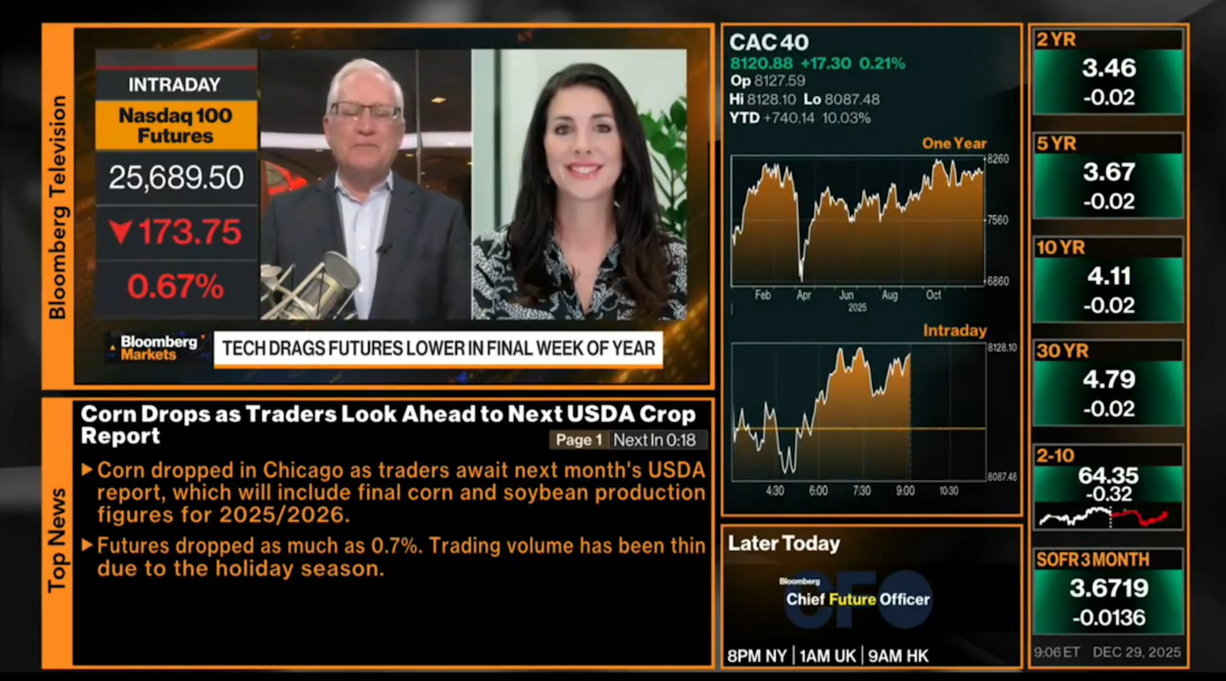
Watch Brooke’s full Bloomberg interview for her 2026 market outlook. ⬇️
Transcript:
Brooke May is in the house with us. Managing partner at Evans May Wealth.
So, Brooke, are you in line with these 21 prognosticators surveyed by Bloomberg who all think the market’s going to go higher in 2026?
We are. And if you’re contrarian, I guess that’s a little scary. But we have a 7700 price target on the S&P by year end of 2026.
And we think that GDP will be up 2%, 2.5%, maybe higher. In addition to that we’re projecting 15% earnings growth. And with midterm elections coming up, we can expect fiscal stimulus in addition to the impact from tariffs fading. So, all that is an environment where you want to be in equities.
So, Brooke you want to be in equities. And we’ve seen leadership in the equity markets really for the last I’m going to say three years being that the big tech names, whether you want to call them the Mag 7 or not. And that’s all well and good. It’s been working, but we’ve been searching for some breadth in this market. At some point is that going to be important for this market?
Do we need this market to broaden out?
We don’t necessarily need it, but I think it’s coming and it’s exciting. You know, two years ago, two-thirds of the return on the S&P 500 came from the Mag 7. For 2026, we think that less than half of the return will come from the Mag 7. So, it’s not necessarily that you want to own one over the other.
It’s that we are getting that broad participation, which is great. Over the last few months, 60% of the companies within the S&P 500 have actually beat the index. And year-to-date, the top 25 performers, none of them are Mag 7 companies, which is hard to believe considering where we’ve been the last few years. So, you know, when you look right now, you can own the broad market and still perform.
In addition to that, whenever we get a broadening, you can move down the capital structure. And so, it doesn’t necessarily just have to be mega-caps in your portfolio. You can start to buy mid- and small-cap companies. That said, we are staying high quality.
We have seen a rally in lower quality small- and mid-cap companies until just recently. But I think that you want to stick to high quality for the foreseeable future. You typically want job growth and strong ISM manufacturing data to see small cap really rally. So that’s why we’d like to stay high quality. I don’t know that we’ll get those factors in the near term.
What is high quality? What are the measures that you’re using to discern whether it’s high quality?
We want to see earnings growth, and we want to see low debt levels. You know, we think that the more debt you take on or the higher multiple that you’re trading at, the more risk there is in those companies. And so, we like to see companies with free cash flow and strong earnings growth consistently.
Hey Brooke, we’ve had some really good earnings in 2025. Just thinking about the last couple of quarters I think really surprised to the upside here.
As we look forward, is the earnings growth story in this marketplace enough to support equities here?
It is. You know, the market is expensive. And it’s trading at 23 times forward earnings. So, we don’t think that 2026 is going to be a year of multiple expansion. We think it’s going to be a year of accountability.
So last quarter’s earnings calls, more than half of management indicated that they’re investing in AI. This year we’re going to see, okay, what are the fruits of those investments? What’s the return on investment? So, we’ve seen AI spend up about 65% this year. And I don’t think it’s sustainable to grow at that rate.
However, companies are going to continue to spend. Right now, only about 37% of companies have effectively adopted AI. And we think in three years that will be as high as 75% of companies. So, to get there, there’s going to need to be spending. But, you know, back to your question on earnings, when we look back, you know, we had great Q3 earnings growth, up about 13%.
We think we’ll be up about 8 or 9% in Q4. And, you know, we think 2025 or 2026, we’re going to have about 15% earnings growth. So, all that is a pretty good environment to be an equity investor.
But what does that AI adoption mean for the labor market? And therefore, the ability of the consumer at the moment to be buying? And for some of your bets on some of the smaller caps to do well?
Yeah. You know, Goldman came out with a study not too long ago indicating that they think that AI could displace about 7% of the workforce in the coming years. So that is a shift. But it’s not monumental. You know, there will be people that are impacted.
But if you look over time, we’re increasing. We’re always increasing productivity. You know, we’re, right now, generating more productivity than we were pre-COVID. So, with that, you do have a smaller labor force. That said, in the US, we’ve got a demographic that, you know, we’ve got an older population that doesn’t bode well for the labor market.
So, as we lose jobs, you know, it won’t be as impactful as it potentially could be. However, easier said than done, but there are employees or, you know, portions of the labor force right now that don’t have the right skill set to do well in the labor market in the future. So, I do feel there’s some retraining of skill sets and migration to more of the job opportunities that would support AI.
Hey, Brooke, how about the bond market here in 2025? Solid high single-digit returns here pretty much across the board here. How do you think the opportunities stack up for ‘26?
I think it’s a decent time to continue to be a bond investor. You know, as you mentioned earlier, it was hard finding yield a few years ago.
And right now, you can get a decent yield on bonds. But that’s going to come down as we see interest rates cut. Right now there’s only about a 20% probability that we’ll see a January rate cut. Granted, that meeting’s going to be at the end of January, and we could get some data points between now and then.
That said, you know, we think that it’s a good time to be a bond investor if we get 2 or 3 rate cuts next year, we’re going to see some price appreciation in bonds. And that coupled with the coupon, you know, gets you some return that you couldn’t get a few years ago.
What if we don’t get the 2 to 3 rate cuts? Is that one of the macro headwinds that you’re having to bake in? Because it feels as though the consensus, as we said, is optimism and that the fed will do what everyone anticipates. But there are these terrorists.
It’s all hinging on the labor market. You know, we’ve seen softening in the labor market. Unemployment now is at 4.6%.
Could tick higher. And there’s going to be a lot of pressure on the fed. You know, the new fed chair is likely going to be very dovish. And so, I don’t know that we’ll have the challenges in getting those rate cuts. If we see a softening labor market because inflation is coming down, you know, when you look at core CPI, you know, it’s down to two, what, 2.6% year-over-year.
It’s not at 2%, but it’s grinding lower. And when you look at core CPI, you know, the component that factors out food and energy, 44% of it is shelter. And shelter hovered above 5% for a prolonged period of time. Now, the most recent read, shelter, is only up 3% year-over-year. And there’s a lot of focus on affordability right now going into the midterm elections.
So, if we can see that shelter component continue to decline and CPI get closer to 2%, then the fed is going to have a lot easier time cutting rates. And if we see the labor market continue to soften.
Hey, Brooke, about 30s left. What’s the conversation you have with your clients about alternative investments?
You know, clients want alternatives. We’re in the Midwest, though, and there tends to be more of an interest in knowing what you own and simplicity. That said, we’ve got clients on the coasts. In addition to Midwesterners.
So, we’ve incorporated private credit into the portfolio. That said, we’re very cognizant of the leverage within our private credit component. There are some real estate investments that we like. We continue to like senior housing. Also, we’ve invested in some build-to-rent communities and multifamily housing.
So, you know, we do incorporate alternatives. However, we like equities and bonds just as much.
Absolutely. Brooke, thanks so much for joining us. Really appreciate it, Brooke.