

Brooke May on Bloomberg Businessweek 11/5/2026: Markets React to 2026 Midterm Elections
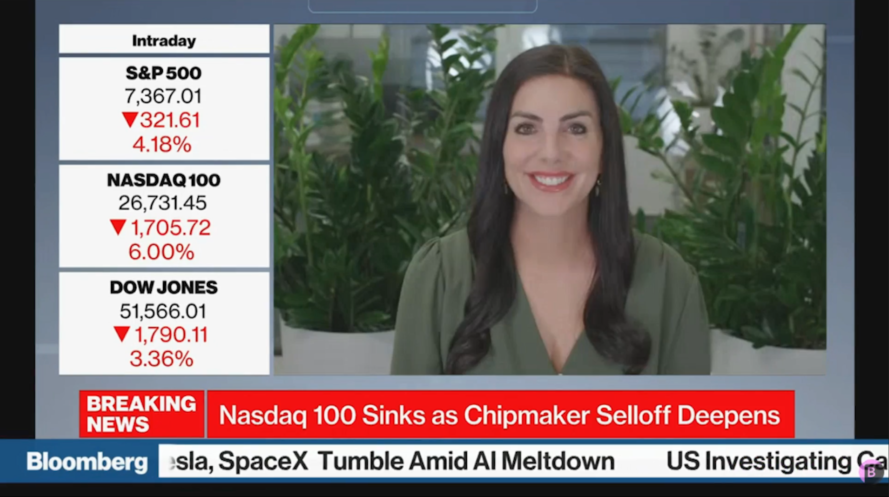
The biggest risk for investors right now is panicking.
Following Tuesday’s midterm election, markets have seen sizable shifts in both directions. But this isn’t something investors haven’t seen before.
Oftentimes when people get out, they don’t get back in at a lower price. Watch Brooke’s Bloomberg interview for more insights. 👇
Transcript:
Are you changing your outlook at all based on what you’ve seen this week?
Tim: I want to bring in Brooke May, Managing Partner at Evans May Wealth, joining us from Indiana today. Hey, Brooke, welcome back to the program. What a day to have you join us when we’re seeing, at least, at one point today on the Nasdaq 100, the worst selloff going back to March of 2020. Are you changing your outlook at all based on what you’ve seen this week?
Brooke: Good afternoon, Tim. You know, I think that looking down under the hood and figuring out exactly what you own is, is prudent right now. I think, whenever we have a, a sector or an area of the economy boom, inevitably there’s going to be some winners and some losers. And, you know, those losers are coming to fruition.
So, you can’t go in and indiscriminately buy right now on this dip. You want to be selective, and you want to own names that you know who are going to benefit from the broad economy, from corporate earnings, and not necessarily have issues with overspend and capex relative to relevant to, to AI.
What’s today like for you when you’re managing clients’ money?
Carol: So, Brooke, what’s today like for you when you’ve got, you’re managing folks’ money?
And I don’t know whether they’re calling and saying, “This has me worried. I want to be all out. Like give me everything, put me in cash or whatever.” And I’m just-
Tim: I hope they’re not
Carol: I’m just curious. Like what? What are the kind of calls you are getting? What’s the day like for you as someone who’s got to be watching these people’s money?
And I know it’s a longer-term play, but nonetheless, I think we’re all trying to figure out what is the longer-term AI story. There’s still lots of demand out there. We’ve heard it over and over and over today. But there’s still a lot of questions.
Brooke: Interestingly, my inbox hasn’t been flooded, and the phone hasn’t been ringing off the hook.
A lot of our clients are high-net-worth and ultra-high-net-worth. And they’ve been through this. You know, they’ve been through a pandemic, a great, a great financial crisis, a tech bubble burst. And so, they know that it’s going to come back. I do expect some, some inquiries, but right now, today was a busy day, just because we were focusing on trying to figure out what’s going on and if there is action that we want to take, trying to, you know, the day has evolved.
You know, it’s it’s interesting because yesterday we had this exuberance around potentially there being a resolution to the conflict with Iran. And then, you know, what that could do to oil prices. And then today you come in and, you know, there’s concern around AI data center build and capex around AI and what that could potentially do to the economy.
You know, interestingly, I was looking at fed funds futures yesterday, and there was about an 80% probability of a rate hike in December. And at one point today, the probability had dropped to 7 or 66%. And I think it’s rebounded a little since. But, you know, the concern is that capex is going to, is going to completely fall off when it comes to AI spend.
And what does that mean to GDP and is it going to throw us into a recession? And I think all that’s highly unlikely.
Are you buying today?
Tim: Brooke, are you buying today?
Brooke: Not today. I think that we’ll wait and see how things settle. But I do think that this is a buying opportunity to see the Nasdaq off 15% from its high.
We really like dividend stocks. And we’ve been in dividend stocks this year, and it’s it’s really been beneficial to our clients. Interestingly, consumer staples are really only about 1% or 2% from their all-time high. So, you know, while Mag 7 and Big Tech is really struggling right now, corporate earnings are strong.
And while today there’s a lot of selling, you know, when you’ve got earnings that are up 30% year-over-year and you’re looking at 15% profit margins, not just this quarter but likely over the next three quarters, it’s a healthy environment to be an investor, and we don’t see that changing overnight.
If markets bounce back tomorrow or start to, would you then be buying into that market environment?
Carol: If markets bounce back tomorrow or start to, would you then be buying into that market environment?
Brooke: Yes. Yes. I do think that this is a healthy environment. You know, when you’ve got a strong labor market, which unemployment is at 4.2%, and consumer spending has been very strong.
You know, that’s the type of environment where the economy is going to stay afloat. It’s not a perfect labor market. You know, as we know, wages are only growing at about 3% year-over-year. And a year ago, they were growing at about 3.8% year-over-year. So, we’ve seen a slowing in wage growth at the same time that we’ve seen an increase in inflation.
We’ve got headline CPI at 3.7%, PCE at 3.6% and producer price index up 6.3% year-over-year. And none of that includes really diesel prices at $7 a gallon. We know that it takes about six months to see those feed through to consumer spending, or consumer prices. 65% of goods are shipped via truck. So, we haven’t tackled inflation.
And so, I think the fed is, you know, that’s really going to be their focus in the near term. And they don’t necessarily have to worry about the labor mandate right now.
Do you think we will actually see policies on affordability being successfully passed by a Democratic House and Senate and a Republican president?
Tim: It’s also going to at least if you take with, you know, credence that the the folks who are voted into office, it’s going to be their focus as well, if they successfully can, you know, try to get cost of living under control or address concerns of affordability that that voters have, Brooke.
Do you think that that you will actually see policies on that front being successfully passed by a Democratic House and Senate and a Republican president?
Brooke: I do. You know, oftentimes campaign promises don’t necessarily come to fruition in legislation, but I definitely think that, you know, every politician this year ran on, affordability, and improving affordability.
And so now it’s time to get to work, roll up their sleeves and focus on how they’re going to tackle inflation. And, you know, make, make, the day-to-day expenses that, you know, households have much more attainable. So, I think that there will be legislation, and I think that it wouldn’t be good optics for anything related to affordability to be vetoed.
So, you know, right now, you know, the GOP is going to be focusing on 2028 and how can we get a different outcome than what we saw two days ago? And I think that you have to be cautious when it comes to some of the legislation and how it could potentially benefit the the broad, the broad constituents.
What do you think is the biggest risk in this environment? What could investors possibly get wrong here?
Carol: Brooke, what do you think is the biggest risk in this environment, what investors could get possibly wrong here?
Brooke: I think that, you know, there’s a risk in panicking and trying to get out of the market as opposed to being selective and figuring out what it is you own. Oftentimes when people get out, they don’t get back in at a lower point.
And so, I think that could be the potentially biggest misstep. Those that you know see days like today and think this is the beginning of the end and, you know, try to get out of the market. You know, we’ve had several years of really strong returns. So, oftentimes there are tax implications to doing that. And it’s really hard to get back in at a lower price.
So, you know, we’re sure, you know, if we get calls, if we start talking to clients and they are fearful, you know, the conversation will be around, “We can ride this out. We’ve done it before. We can do it again.” You know, overall corporate earnings are strong. We’ve got a good labor market.
And, you know, while capex spend has come into question, you know, it’s about 1.8% of GDP for 2026. That’s meaningful. But if we see a slight downtick, you know, one-tenth or two-tenths of a percent, it’s not going to derail the economy. There will be winners and losers. And, you know, you can buy-
Carol: You’re talking about data center 1.8%?
Brooke: Yes. AI capex spend. Sorry.
Carol: That’s okay, just wanted to clarify.
Brooke: AI capex spend 1.8% of GDP.
Carol: Yeah. No, it’s it’s it’s super interesting.
What’s a trade that you’ve made for your investors or strategy leading up to the elections, or were you just all hands off?
Carol: I am curious, what’s a trade that you’ve made for your investors or strategy in the last week or so or leading up to the elections, or did you just, were you like all hands off?
Brooke: We haven’t made any tactical shifts. You know, several weeks back, we were evaluating our small cap exposure. You know, the fear that we would see higher interest rates and what that could potentially do to small cap.
But we we decided to keep our allocation and just keep it, you know, monitor it. We’re also reevaluating our position in gold. We did pare it back earlier in the year. And you know, with the recent volatility, it’s probably something that we’re going to continue to assess and potentially make shifts in.
Carol: All right. Super interesting.
I’m just taking a look at what gold prices are doing in today’s session. Let me just pull it up for everybody. See if it’s being seen as a safe haven. And it was up 2% earlier in today’s session. But right now, a gain of about nine-tenths of a percent.
Brooke, thank you. Take care. Brooke May, Managing Partner at Evans May Wealth.