The first half of 2026 reinforced an important lesson for investors: financial markets can continue to advance even amid heightened uncertainty.
Inflation remained above the Federal Reserve’s long-term target, geopolitical tensions periodically weighed on investor sentiment, and expectations surrounding monetary policy shifted throughout the first six months of the year. Despite these headwinds, the U.S. economy remained resilient, corporate earnings continued to exceed expectations, and equity markets reached new record highs.
Through June 30th, the S&P 500 gained 10.21%, delivering its strongest second-quarter return during a midterm election year in nearly 80 years. Importantly, the market’s advance has been supported primarily by earnings growth rather than expanding valuations, providing a healthier foundation for long-term appreciation.
As we enter the second half of 2026, investors remain focused on whether these favorable fundamentals can continue. While uncertainty is unlikely to disappear, resilient corporate profits, moderating inflation, improving market breadth, and a gradually normalizing economy continue to provide a constructive backdrop for long-term investors.
Exhibit 1: S&P 500 Performance If You Initially Invested $5,000 on January 1, 1970
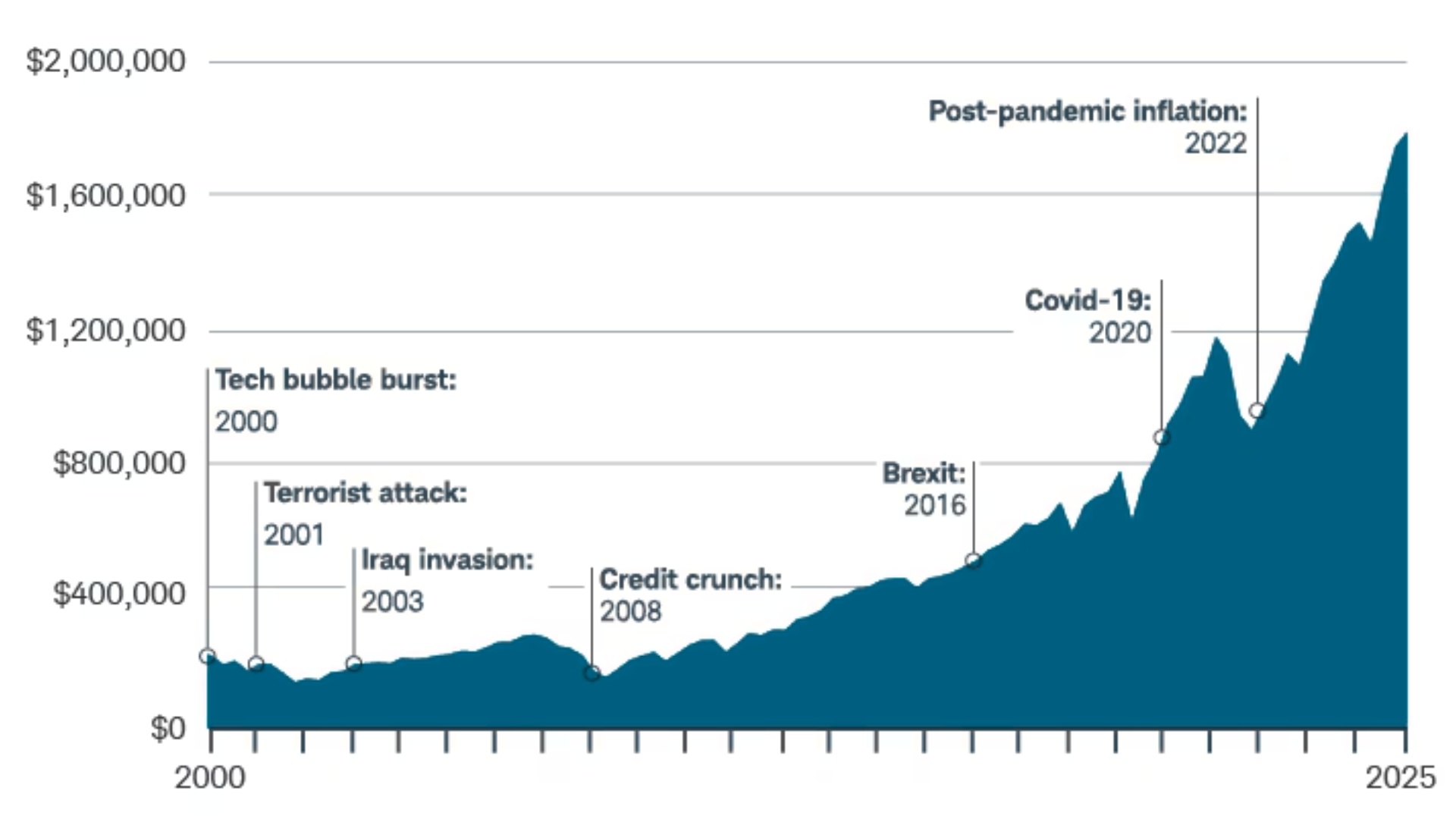
Source: Schwab Center for Financial Research with data from Morningstar
Market Perspective
One of the defining characteristics of 2026 has been the market’s ability to look beyond short-term uncertainty and remain focused on underlying fundamentals. Investors have navigated persistent concerns surrounding inflation, Federal Reserve policy, geopolitical conflict, energy prices, and fiscal policy, yet equity markets have continued to reach new highs.
This resilience reflects an important characteristic of financial markets: stocks respond not simply to uncertainty, but to how economic conditions evolve relative to expectations. Although headlines have often reflected elevated uncertainty, the broader economic backdrop has remained supportive. Corporate earnings have continued to grow, inflation has gradually moderated, labor market conditions remain healthy despite slowing, and market leadership has expanded beyond the largest technology companies.
Rather than relying on speculative enthusiasm or rapidly expanding valuations, this bull market continues to be supported by improving corporate profitability and broader participation across sectors, characteristics that have historically been associated with more durable market advances.
Corporate Earnings Remain The Foundation Of This Bull Market
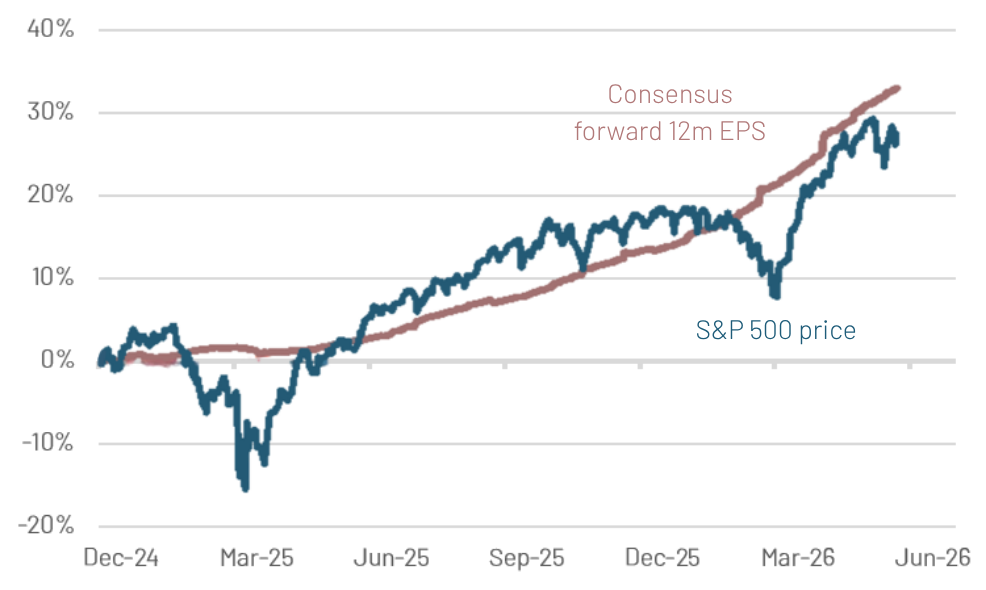
A defining characteristic of the current market cycle has been the extent to which earnings growth, rather than valuation expansion, has driven equity returns.
Exhibit 2: Cumulative S&P 500 Change Since The Start of 2025
Source: FactSet, Goldman Sachs Global Investment Research
As of June 30th, the S&P 500 has appreciated approximately 22% over the last 12 months, while the forward price-to-earnings ratio has remained near 20x, suggesting that corporate profitability, rather than higher investor valuations, has been the primary driver of market returns.
Current estimates suggest earnings momentum remains intact entering second-quarter reporting season. The consensus estimate is for S&P 500 earnings to grow approximately 23% year-over-year, the strongest pre-earnings-season estimate since 2021. Analysts continue raising earnings expectations rather than lowering them. 57% of companies issuing earnings guidance have provided positive guidance, the highest percentage since 2021. The Information Technology sector has also posted a record number of positive earnings preannouncements.
As Q2 reporting season unfolds, company results and forward guidance are likely to play an increasingly important role in shaping market expectations.
Inflation, Interest Rates, And Fixed Income
Inflation has continued to move closer to the Federal Reserve’s long-term objective, although progress has remained uneven across sectors of the economy. Moderating price pressures, combined with slower employment growth, have allowed the Federal Reserve to maintain a patient, data-dependent approach to monetary policy.
While the timing of future interest rate adjustments remains uncertain, especially under the leadership of new Fed Chairman Warsh, the broader trend remains encouraging. Continued progress on inflation, coupled with a gradually moderating labor market, supports a more balanced economic outlook and reduces the likelihood of additional monetary tightening. Although monetary policy will remain an important source of short-term market volatility, long-term market performance continues to be driven primarily by corporate earnings and broader economic fundamentals.
Higher interest rates have restored fixed income’s role as a component of diversified portfolios. As of June 30th, the 10-year U.S. Treasury yielded approximately 4.4%, providing investors with income opportunities that were largely unavailable throughout much of the previous decade. While interest-rate volatility is likely to persist, today’s yield environment allows high-quality fixed income investments to once again provide meaningful income while helping diversify portfolios during periods of equity market volatility.
The Labor Market Is Cooling, Not Cracking
The labor market continues to moderate following several years of exceptionally strong employment growth, consistent with a broader normalization of economic activity.
June payrolls increased by 57,000, below expectations of 115,000, while April and May payrolls were revised lower by a combined 74,000 jobs. The unemployment rate declined to 4.2%, although much of that improvement reflected lower labor force participation, which fell to 61.5%, its lowest level since March 2021.
Although hiring has moderated, broader labor market conditions remain relatively stable. Initial unemployment claims remain relatively low by historical standards, layoffs have not accelerated meaningfully, wage growth has moderated, and lower gasoline prices continue to support consumer spending. Taken together, recent data suggest the labor market is transitioning toward a more sustainable pace rather than signaling a material deterioration in economic conditions.
Market Leadership Is Broadening
For much of the past two years, market performance was concentrated among a small group of artificial intelligence leaders commonly known as the “Magnificent Seven.” One of the more notable developments during the first half of this year has been the broadening of market leadership.
Financials, industrials, select cyclical sectors, small-cap stocks, and the equal-weight S&P 500 have recently outperformed, reflecting broader participation across equity markets beyond the largest technology companies. We expect this trend to continue during the second half of the year as earnings growth expands across additional sectors.
Artificial intelligence remains an important long-term investment theme. Analysts estimate AI infrastructure companies will contribute nearly 60% of total S&P 500 earnings growth this quarter, with Micron and NVIDIA alone accounting for more than 40% of expected earnings growth. Although semiconductor stocks recently experienced a correction following an exceptional rally, continued investment in data centers, networking equipment, and semiconductor manufacturing suggests the long-term AI investment cycle remains intact.
Historically, broader market participation has been associated with more durable bull markets and may indicate improving underlying market breadth.
Energy Markets Remain A Key Variable
Another notable development during the second quarter was the decline in oil prices following an easing of tensions in the Middle East. After briefly climbing above $110 per barrel during the Iran conflict, Brent crude fell to approximately $72 per barrel as of June 30th, helping ease inflationary pressures and reduce energy costs across the economy.
More recently, however, oil prices have moved higher as geopolitical tensions in the Middle East are escalating again. This recent rebound in oil prices highlights that energy markets are likely to remain sensitive to evolving global events.
Although energy prices remain below the highs reached earlier this year, sustained increases could place renewed upward pressure on inflation and influence expectations for Federal Reserve policy. As a result, energy prices will remain an important variable to monitor during the second half of the year, even as the broader economic outlook continues to be supported by resilient corporate earnings and moderating inflation.
Looking Ahead
Looking ahead, the macroeconomic backdrop remains broadly constructive. Corporate earnings continue to provide the primary foundation for equity markets, inflation is gradually moving toward the Federal Reserve’s objective, labor market conditions are normalizing rather than deteriorating, and improving market breadth suggests that participation in this bull market is becoming more balanced across sectors.
Geopolitical developments, Federal Reserve policy, and incoming economic data will likely continue to generate periods of volatility. Renewed tensions in the Middle East, in particular, remain an important risk to monitor, as a sustained escalation could place upward pressure on energy prices, contribute to higher inflation, keep bond yields elevated, and could increase the odds of delayed Federal Reserve rate cuts or even rate hikes.
While these risks warrant continued attention, periods of uncertainty are a normal feature of investing rather than an exception. History has consistently shown that long-term market returns are driven primarily by earnings growth, economic fundamentals, and disciplined investment strategies, not by short-term headlines. Maintaining diversified portfolios focused on high-quality businesses and durable earnings growth remains the most effective approach for navigating changing market environments.
Download a PDF version here.
Sources: Sanctuary Wealth, Goldman Sachs, First Trust, Charles Schwab, J.P. Morgan, Yardeni
Sanctuary Wealth makes no representation as to the accuracy or completeness of information contained herein. Any forward-looking statements are based on assumptions, may not materialize, and are subject to change without notice. The information is based upon data available to the public and is not an offer to sell or solicitation of offers to buy any securities mentioned herein. Any investment discussed may not be suitable for all investors. Investors must make their own decisions based on their specific investment objectives and financial circumstances. Investments are subject to risk, including but not limited to market and interest rate fluctuations. Any performance data represents past performance which is no guarantee of future results. Prices/yields/figures mentioned herein are as of the date noted unless indicated otherwise. All figures subject to market fluctuation and change. Additional information available upon request.